
India and Mercosur After EU Agreements: Two Different Paths Towards Internationalisation
On Friday 24 April 2026, during the webinar organised in collaboration with ELITE, we addressed an issue. For many Italian businesses, it is no longer merely a matter for international observers: it represents a concrete shift in commercial strategy. The focus was on the recent agreements between the European Union and India on the one hand, and between the European Union and Mercosur on the other.
The starting point is clear. Europe is not signing these agreements merely to reduce tariffs. It is using them as levers for industrial policy, economic security, the strengthening of global value chains and geopolitical repositioning. India and Mercosur are two distinct dossiers, yet united by the same logic: to expand Europe’s economic and strategic reach into areas with high growth potential.
On the one hand, there is India, with which the EU concluded negotiations on the Free Trade Agreement on 27 January 2026. On the other, there is Mercosur, with which the EU signed an agreement on 17 January 2026 aimed at creating one of the largest integrated trade areas in the world, involving around 700 million people across Europe, Argentina, Brazil, Paraguay and Uruguay.
For Italian businesses, the issue is not simply a matter of deciding where to export. The key is to transform these agreements into a concrete internationalisation strategy: assessing the actual tariff advantage, selecting priority markets, identifying the right partners, verifying customs regulations and compliance, and building a sustainable entry model.
India: an Agreement that could Unlock a Relationship that Remains Underdeveloped
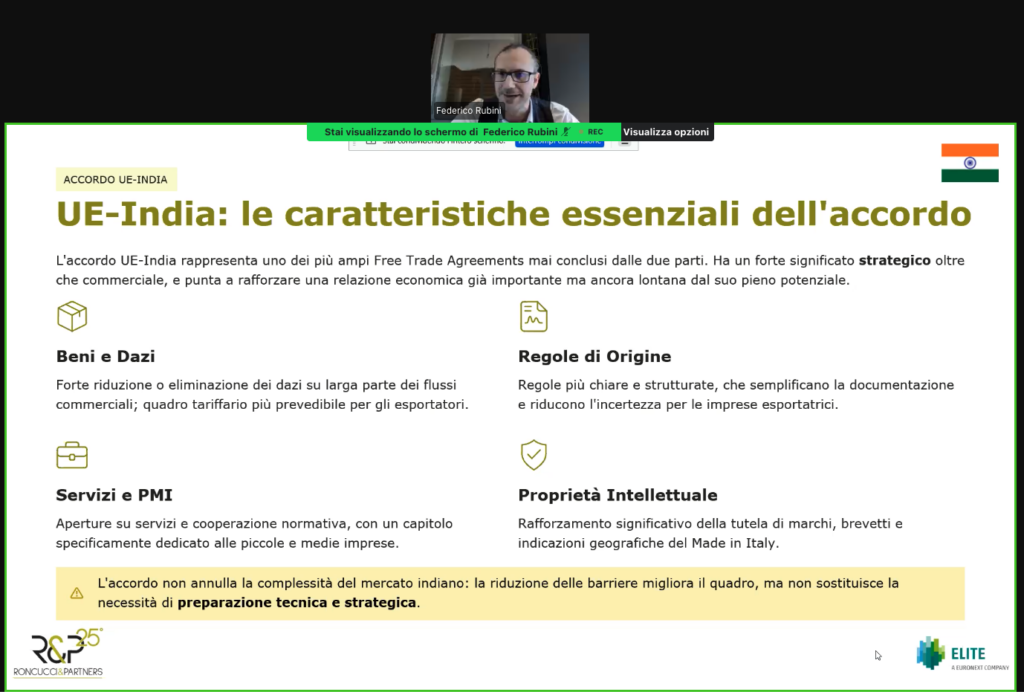
In the case of India, the most interesting fact is perhaps this: the economic relationship between Europe and India was already significant, but still far from reaching its full potential. The new EU-India agreement is one of the most comprehensive free trade agreements ever concluded by the two parties and aims to strengthen a strategic economic relationship, as well as a commercial one.
To date, many European companies have continued to view the Indian market as promising, yet difficult to penetrate. The reasons are well known: high tariffs, regulatory barriers, uncertainty regarding the timeframes and costs of market access, regional differences, a highly fragmented commercial distribution network, and the need to adapt products to different local contexts.
This is precisely where the new FTA can change the picture. India will eliminate or reduce tariffs on 96.6% of EU goods exports, whilst the European Commission estimates savings of up to €4 billion a year in customs duties for European exporters.
The Sectors Most Affected by the EU-India Agreement
The expected tariff reductions concern sectors of great interest to the Italian manufacturing industry: machinery, chemicals, pharmaceuticals, automotive, processed foods, textiles, footwear, wine, spirits and olive oil.
Some examples:
- Indian tariffs on industrial machinery, currently up to around 45%, will be reduced to 0%.
- As for the chemical sector, where tariffs currently stand at around 22%, almost total liberalisation is expected.
- For the pharmaceutical sector, the agreement provides for a reduction from around 11% to 0%.
- The change is also significant in the automotive sector: tariffs on cars, currently up to around 110%, may be progressively reduced to around 10%, subject to the conditions set out in the agreement.
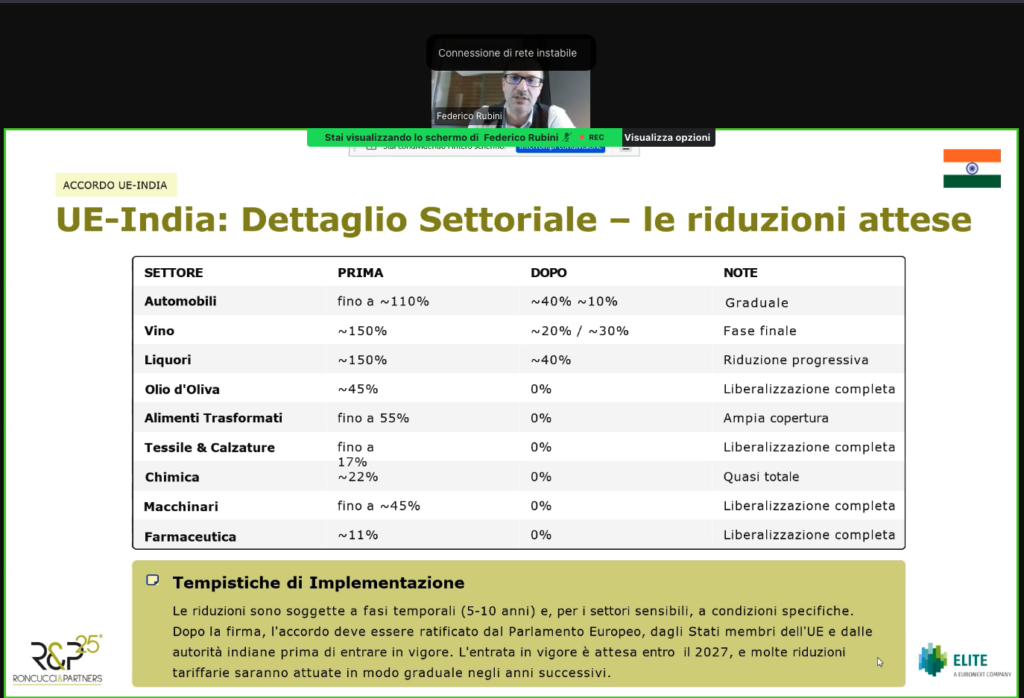
These figures do not mean that India automatically becomes an easy market. They do, however, mean that, for many Italian businesses, it will be easier to assess the actual tariff advantage, review pricing, plan their market entry and develop a more competitive commercial proposition.
Why India is Strategic for SMEs
A less spectacular but perhaps even more important element for the Italian business community is the chapter dedicated to SMEs. The agreement provides for a public digital platform with useful information on market access, dedicated contact points for small and medium-sized enterprises, and a more transparent framework regarding tariffs, procedures, certifications and access requirements.
In other words, the EU-India FTA was not designed solely for large, established groups. It can also become a useful tool for businesses that need better guidance on rules of origin, customs documentation, compliance, certifications and operational procedures.
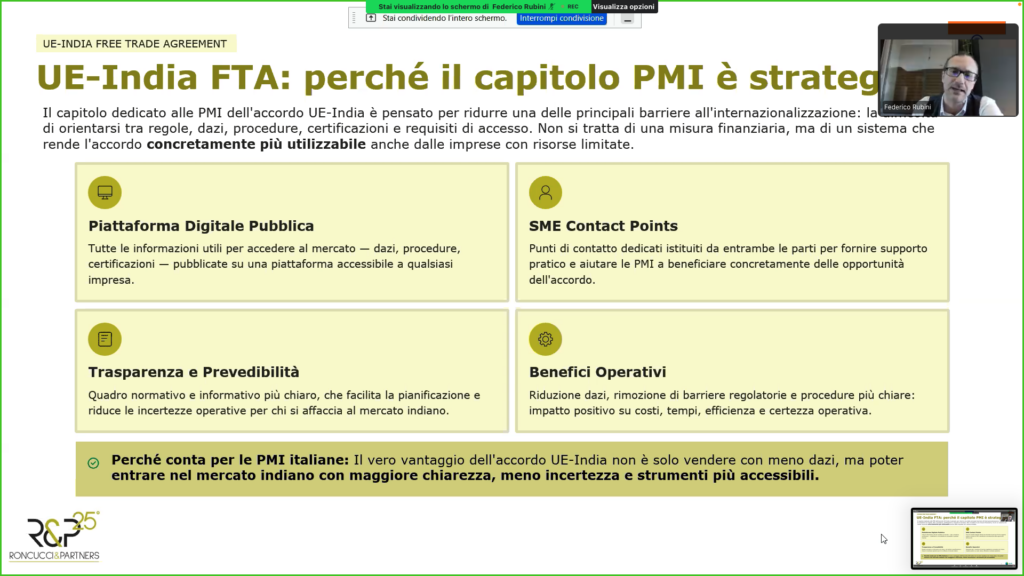
The real benefit of the EU-India agreement, therefore, is not merely about selling with lower tariffs. It is about being able to enter the Indian market with greater clarity, less uncertainty and more accessible tools.
India: a Fantastic Opportunity, but also Highly Complex
India remains a country-continent. It cannot be viewed as a single market. The webinar presentation highlights 28 states with significant territorial, industrial, linguistic and operational differences. The West and South are home to many of the strongest industrial and technological hubs: Gujarat and Maharashtra for industrial output; Tamil Nadu, Karnataka and Telangana for more tech-driven and advanced supply chains.
For this reason, the first mistake to avoid is thinking of India as a single, undifferentiated destination. The agreement improves the competitive landscape, but it does not replace strategy. On the contrary, it makes strategy all the more necessary.
For Italian companies well-positioned in machinery, packaging, pharmaceuticals, components, medical devices, chemicals, premium food & beverage, furniture, fashion and high value-added products, a real opportunity is opening up. But a selective approach is needed: choosing priority states, assessing industrial clusters, verifying compliance and certifications, identifying reliable partners and ensuring commercial continuity over time.
Mercosur: a Door Opens, but the Strategy remains Country-by-Country
On the Mercosur front, the message that emerged from the webinar is different, yet complementary.
We are not dealing with a single, large, homogeneous market, but rather a platform comprising various countries. For this reason, it must be interpreted and managed with great selectivity.
The EU-Mercosur agreement covers Argentina, Brazil, Paraguay and Uruguay. It aims to remove barriers, create new opportunities for European businesses, strengthen access to critical raw materials and ensure safeguards regarding environmental standards, consumers, farmers and European geographical indications.
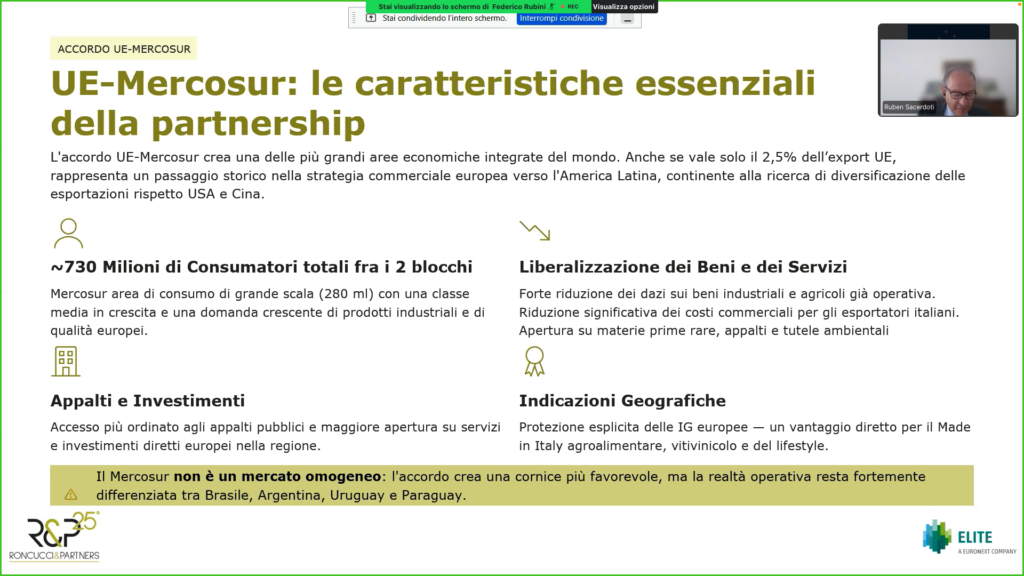
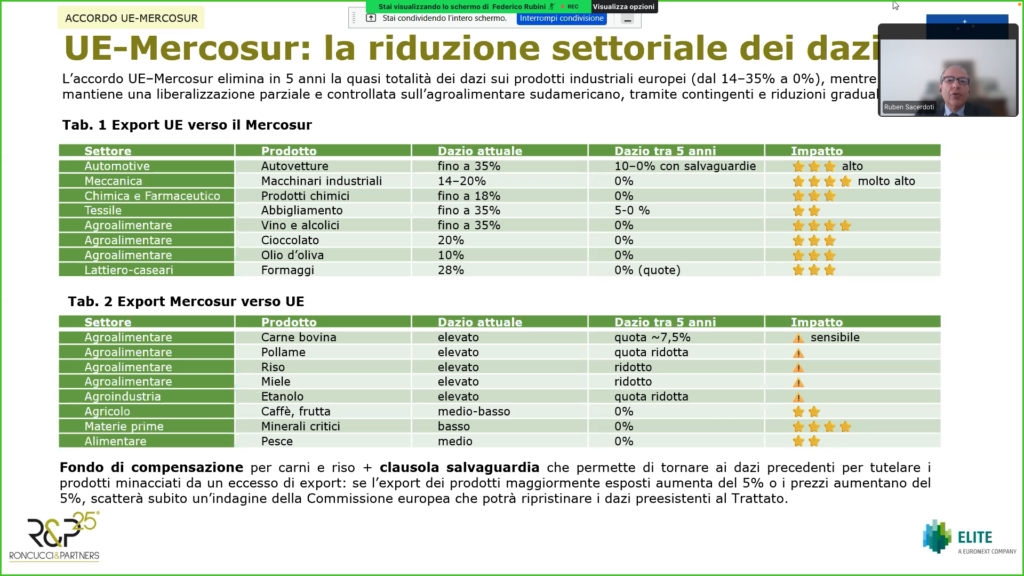
According to the European Commission, the EU-Mercosur trade agreement creates a trading area covering around 730 million people. The agreement provides for the elimination or significant reduction of tariffs on goods and services accounting for over 90% of EU exports, with benefits in sectors of relevance to Italy such as the automotive industry, industrial machinery, chemicals and pharmaceuticals.
The benefits for European and Italian industry
For European industry, the expected benefits are significant.
The agreement provides for the reduction of tariffs on cars, industrial machinery, chemicals, pharmaceuticals, textiles, wine, spirits, chocolate, olive oil and cheese. In particular, tariffs on industrial machinery, currently between 14% and 20%, are set to fall to 0%; those on cars, currently up to 35%, may be gradually reduced to 10% or 0%, subject to safeguards.
The agreement also opens up opportunities in public procurement, professional services and access to critical raw materials. For Italian-made products, another important aspect concerns the protection of European geographical indications, with a direct benefit for the agri-food, wine and lifestyle sectors.
For Italian businesses, the most promising sectors include industrial machinery and equipment, transport, components, the aftermarket, industrial chemicals, pharmaceuticals, technical services, consultancy, engineering, processed and premium agri-food, fashion, textiles, furniture, industrial technologies, energy and infrastructure.
Mercosur Is Not a Single Market
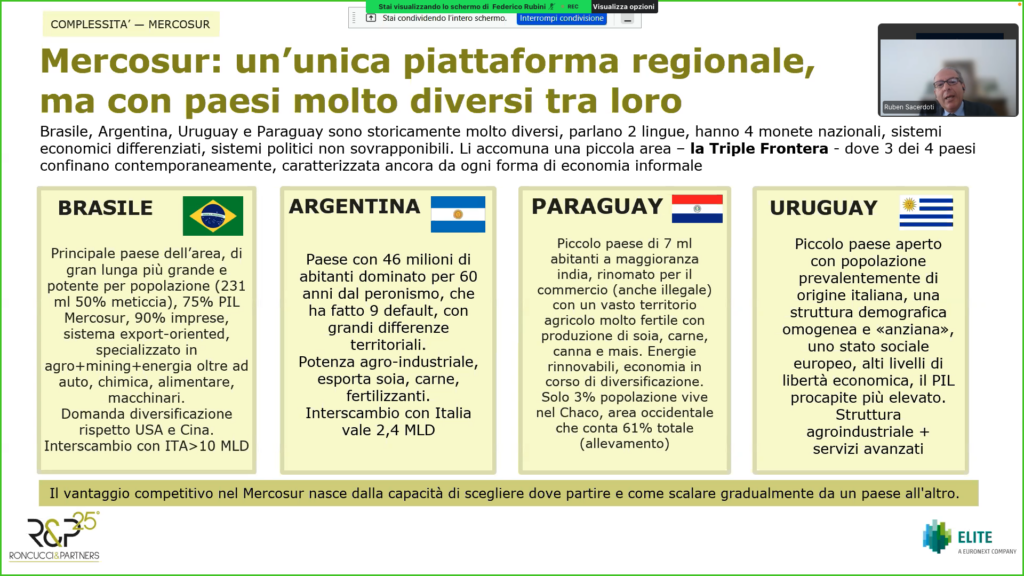
The real strategic point is that Mercosur should not be viewed as a single bloc. Brazil, Argentina, Uruguay and Paraguay are historically, economically and politically very different countries. They speak two languages, have four national currencies, distinct economic systems and operating contexts that cannot be equated.
Brazil carries significant weight in terms of economic size, population and industrial base. Argentina remains an agro-industrial powerhouse, but with a historically higher degree of volatility. Uruguay is smaller, stable and often attractive as a hub for business relations. Paraguay operates on a different model, with an agricultural economy and an ongoing process of diversification.
The agreement provides the framework, but the competitive advantage stems from the ability to choose where to enter first and how to scale up over time from one country to another. In this sense, Mercosur requires a structured, selective and progressive strategy.
Trade Agreements and Internationalisation: What Italian Businesses Need to Do Now
The most important message to emerge from the webinar is simple: agreements do not replace strategy. They make it all the more urgent.
In India, the first steps are to understand one’s customs code, measure the actual tariff advantage, choose the most suitable states and clusters, integrate trade strategy and compliance, and assess the most appropriate entry model from among exports, partnerships, joint ventures or a direct presence.
In the case of Mercosur, the priority is to select the entry country, assess the operational differences between individual markets, use tariff leverage to review pricing, verify rules of origin and standards, and build a regional management model with local execution.
The presentation summarises this process in six concrete steps for Italian companies:
- mapping products and customs codes;
- assessing the actual tariff advantage;
- segmenting priority markets;
- preparing for compliance and regulations;
- reviewing pricing and the entry model;
- and moving before competitors.
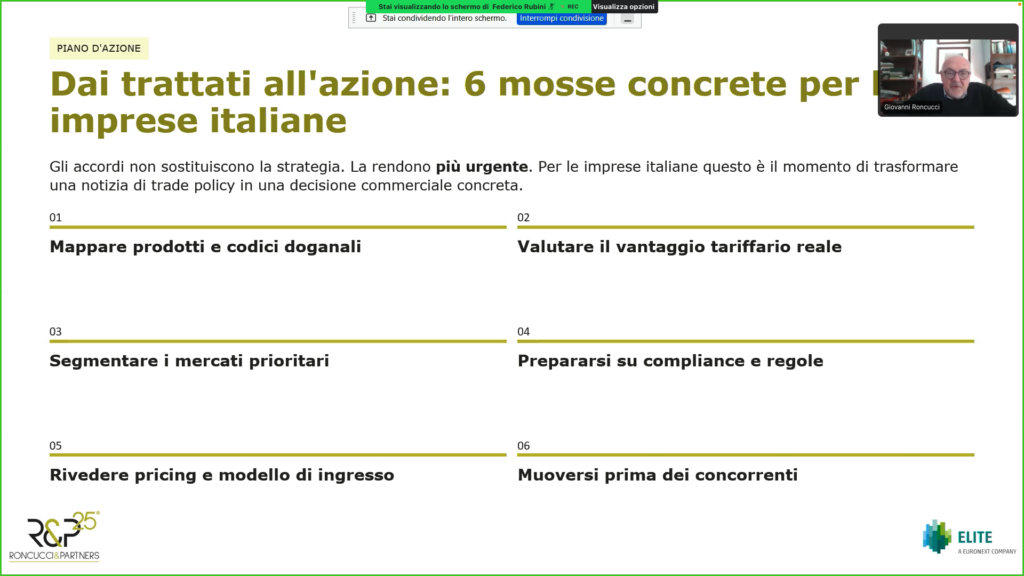
These steps are essential because, while a trade agreement creates opportunities, it does not automatically guarantee results. What will make the difference is the company’s ability to turn trade policy developments into a concrete plan for international expansion.
A Consideration that Closely Concerns Roncucci&Partners
India and Mercosur are not markets to be observed from afar. For Roncucci&Partners, these are regions where we operate directly, with offices in Chennai, Bangalore and São Paulo.
The EU-India and EU-Mercosur agreements open up new opportunities, but they require analysis, a local presence and the ability to execute.
Roncucci&Partners supports companies worldwide in assessing markets, finding partners and defining sustainable entry strategies.
To transform these agreements into a concrete path to international growth, please contact us.
Related Articles: