
Exporting to the United States: Why the U.S. Market Must Be Assessed State by State

For many Italian companies, the United States represents one of the most promising destinations for expanding exports. The size of the economy, consumer spending power, and demand for high-quality products make the U.S. market particularly attractive for numerous sectors of the “Made in Italy” industry.
However, the vastness of the country raises a preliminary question: in which part of the United States are the conditions best suited for the company’s product?
For an export strategy, the United States should be viewed as a collection of 50 state markets, each characterized by significant differences in demand composition, competitor presence, price levels, and market access.
Roncucci&Partners dedicated its July 23, 2026, webinar to this topic: “Big Data for Export: Focus on the United States—How to Identify the Most Promising U.S. Markets Through Data and Methodology,” led by Federico Rubini and Giacinta Acerbi.
The session presented the data-driven approach developed by Roncucci&Partners to help companies make informed decisions about the U.S. market, reducing the reliance on assessments based solely on experience or occasional opportunities.
Entering the U.S. Market Starts with a Choice

When a company decides to export to the United States, the first destination is often identified through an existing business contact. This could be an importer met at a trade show, a distributor who has requested information, or a customer who has expressed interest.
These signals have tangible value and can mark the beginning of a business relationship. However, they represent only a portion of the potential market.
The presence of a contact in a particular state does not necessarily mean that this is the territory where the product will achieve the best results. Similarly, the prominence of California, New York, Texas, or Florida does not guarantee that these states are always the most suitable destinations.
An effective decision should correlate the opportunities that have already emerged with a broader understanding of the market. The goal is to understand where favorable conditions exist to sustain the commercial investment over time.
The question therefore becomes very specific:
In which U.S. state does the company’s product currently have the greatest potential?
Why the 50 States are different Markets
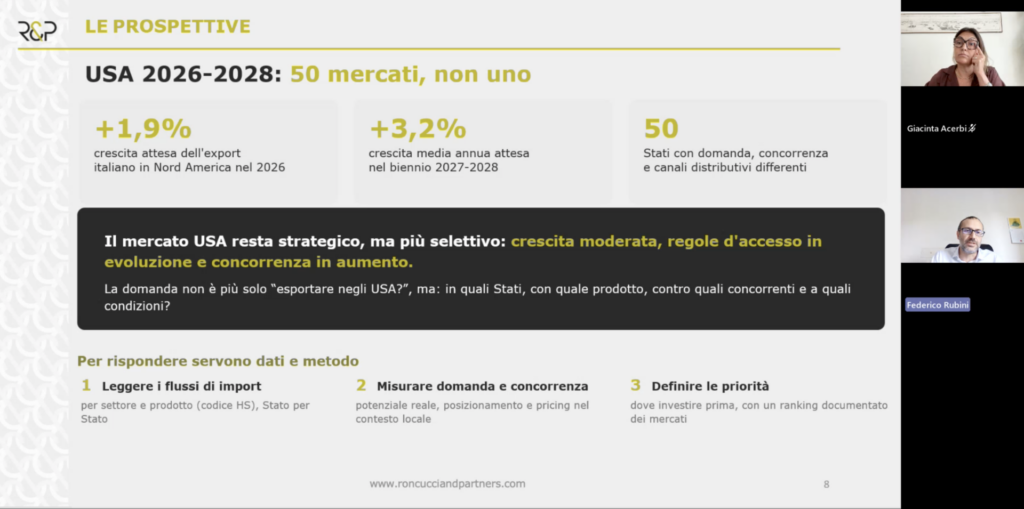
The economic structure, consumer profile, concentration of client companies, and the relative importance of different distribution channels can vary significantly from one U.S. state to another.
The presence of cultural communities, local production specialization, and available infrastructure can also influence a product’s potential.
Industrial machinery may see greater demand in states with a high concentration of manufacturing. A food product may perform better in regions where there is already familiarity with Italian cuisine or a greater willingness to recognize the value of a premium offering.
Price itself takes on a different meaning depending on the context. A product may be well-suited to the high end of a market but face greater challenges in a state with different purchasing behaviors.
For this reason, speaking generically about the U.S. market risks obscuring differences that are critical to a company’s strategy.
A Data-Driven Approach to Guiding Exports to the United States
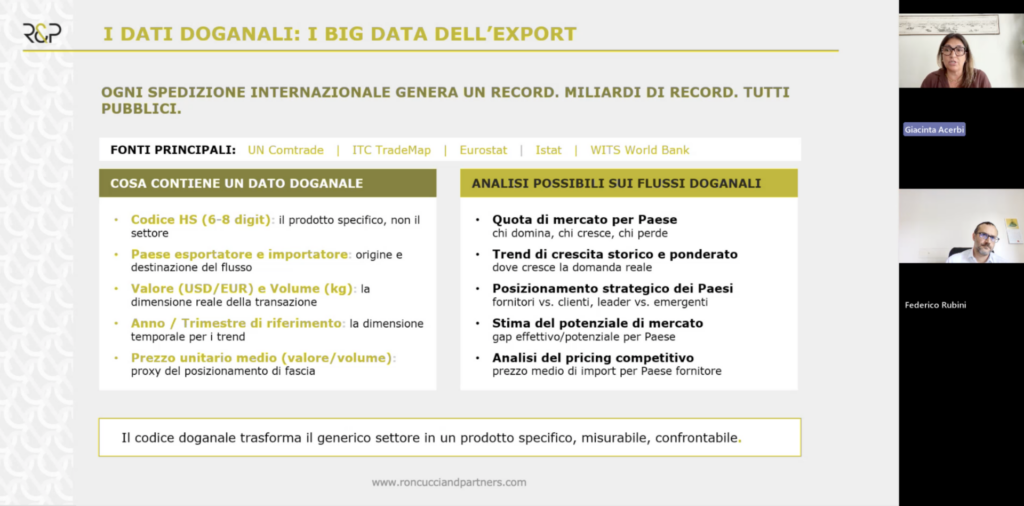
Roncucci&Partners’ approach begins with the collection and analysis of information specific to the company’s product.
The first identifying element is the HS customs code. This code makes it possible to define the scope of the analysis and distinguish a product’s dynamics from the broader trends of its industry.
The assessment then takes into account various categories of indicators. The analysis examines how the product performs in the U.S. market, which regions show the strongest demand, and the level of competition in each state.
These elements are complemented by insights that help understand the product’s positioning, the level of market interest, and the conditions that may facilitate or complicate market entry.
The complete methodology, the weightings applied, and the ways in which the indicators are integrated constitute proprietary intellectual property developed by Roncucci&Partners. The underlying principle of the approach, however, can be clearly stated: a business decision becomes more sound when it is informed by data specific to the product and the market in which the company intends to operate.
From Data to Setting Priorities

Market analysis adds value when it helps a company make decisions.
Collecting large amounts of information, on its own, risks creating complexity. That is why export intelligence must transform the available data into insights that are understandable to the entrepreneur, the export manager, or the sales management team.
The expected result is a roadmap of priorities.
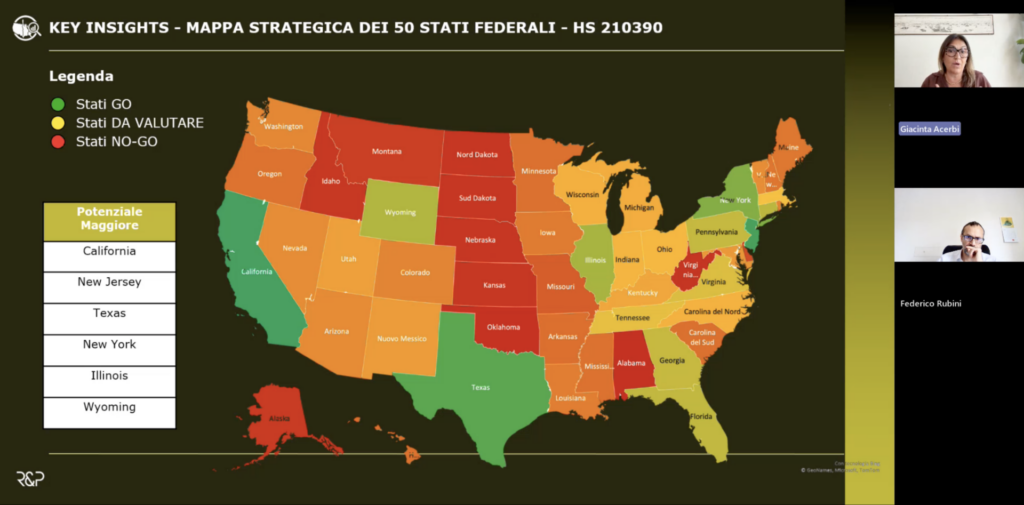
Some countries may offer high potential and favorable conditions for an initial investment. Others may require further evaluation, perhaps due to the presence of very strong competitors or the need to adjust the company’s positioning. Still others may be at a later stage of the commercial journey.
This classification allows the company to focus its resources on markets where there is greater alignment between its product and the characteristics of the local market.
The company can thus plan its market scouting activities, communication campaigns, participation in trade shows, and search for local partners more effectively.
Data for a Better Understanding of the Market

The use of big data for exports does not diminish the importance of firsthand experience.
Engaging with importers, distributors, and customers remains essential for understanding how commercial channels actually function. On-site visits and trade shows also continue to play an important role, especially during the validation and development phases.
Data-driven analysis allows these activities to be approached with clearer priorities.
A trade show may be selected because it takes place in an area consistent with the identified market. Market scouting can focus on countries that show the greatest potential. Interviews with local operators can be used to verify hypotheses already developed on a quantitative basis.
Data and field experience therefore contribute to the same decision, coming into play at different stages of the process.
Selling and Investing Require Different Assessments

A state’s business appeal is just one of the factors to consider when a company is evaluating a direct presence in the United States.
Opening a branch office, a warehouse, or a technical support facility requires a deeper level of analysis.
In this case, the operational sustainability of the location must also be examined. Labor costs, the availability of qualified personnel, the tax environment, and the quality of infrastructure can significantly affect the cost-effectiveness of the location.
The state that is most attractive for sales may therefore be paired with a region that is better suited for managing the company’s operations.
For an Italian company, the strategy may also involve establishing an operational facility in one state while expanding sales to other parts of the country. The choice depends on the product, the distribution model, and the project’s objectives.
From Potential to Market Presence

Identifying priority countries is the first step in the process.
Following the analysis, it is necessary to review the information gathered, identify local contacts, and determine which entry strategy best aligns with the company’s characteristics.
In some cases, the process may begin with an importer. In others, it may be advisable to build a network of regional distributors or launch a direct sales effort targeting selected customers. For more structured projects, it may be important to consider establishing a permanent presence.
Roncucci&Partners also supports companies during the subsequent phases of operational development through market scouting, market validation, and support for market entry. The firm’s presence in Miami also allows it to assist companies directly within the U.S. market.
USA INSIGHT™: Assessing the U.S. Market for a Specific Product
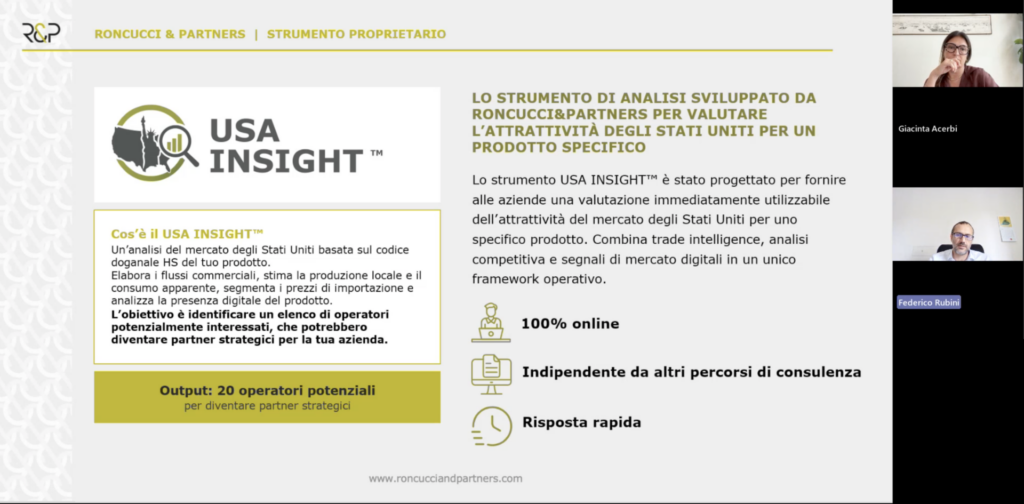
The approach presented during the webinar is implemented in USA INSIGHT™, Roncucci&Partners’ proprietary tool designed to assess the U.S. market.
USA INSIGHT™ starts with the product’s HS code and combines various information sources to provide companies with actionable insights for their business decisions.
The analysis allows companies to compare U.S. states, identify areas with the greatest potential, and understand the product’s positioning within the local competitive landscape.
The process also includes identifying an initial group of potentially relevant business partners, offering companies a concrete link between the analysis phase and the start of business development.
USA INSIGHT™ can be conducted entirely online and used as a standalone project or as a foundation for a subsequent entry strategy into the United States.
Which State Should I Start From?
To answer this question, we must start with the product, examine regional differences, and compare opportunities with the actual conditions for market access.
Export intelligence helps reduce the waste of resources and enables the development of a more selective strategy. In a vast market like the United States, choosing where to focus the initial investment can have a decisive impact on the outcomes of the entire project.
Interested companies can send Roncucci&Partners the HS code of their product to request an initial analysis focused on the United States.
Related Articles:
https://roncucciandpartners.com/2026/06/23/export-alimentare-potenziale-mercato/
https://roncucciandpartners.com/2026/06/30/export-giappone-corea-sud-pmi/