
Food Export: Assessing the True Potential Before Choosing a Market
Data, Demand, Pricing, and Positioning: The Roncucci&Partners Webinar Featuring a Testimonial from Campo d’Oro on “Made in Italy” Food Export.
How to Choose a Foreign Market for Food Export
On June 11, Roncucci&Partners held a webinar titled “Food Export: Before Entering a Market, Assess Its True Potential”. The webinar aimed at agri-food companies interested in evaluating growth opportunities in international markets in a more systematic way.
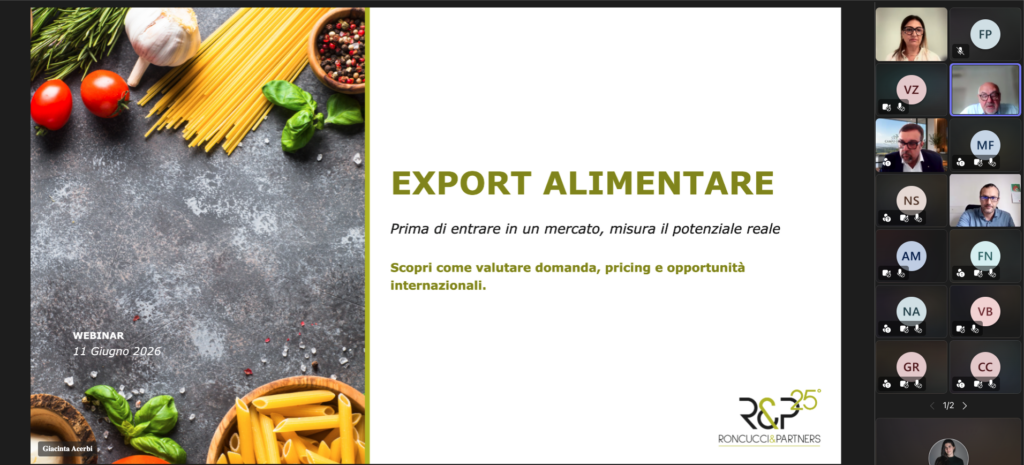
Our initial question was simple but crucial: How can you tell if a foreign market is truly suitable for your food product?
The answer cannot be based solely on intuition, a trade show, or a business contact. Today, you need data, demand analysis, price analysis, competitive analysis, and a clear assessment of your positioning.
The meeting began with some background context: the food sector continues to be one of the most significant segments of the global economy, but it is also an increasingly competitive, selective, and complex market. Global population growth, the expansion of the middle class in emerging countries, changing consumer habits, and the transformation of distribution channels make the agri-food sector a field rich in opportunities, but one in which market decisions must be made with ever greater awareness.
“Made in Italy” Agri-Food Export: A Positive Picture, but Not Without Its Variations
Positive Outlooks
For Italian companies, the outlook remains positive. In 2025, “Made in Italy” agri-food exports reached approximately 72.5 billion euros, representing a 5% increase over the previous year1. Between 2019 and 2025, the sector’s foreign sales grew at a compound annual growth rate of 8.1% 2, confirming the strength of the Italian agri-food sector in international markets.
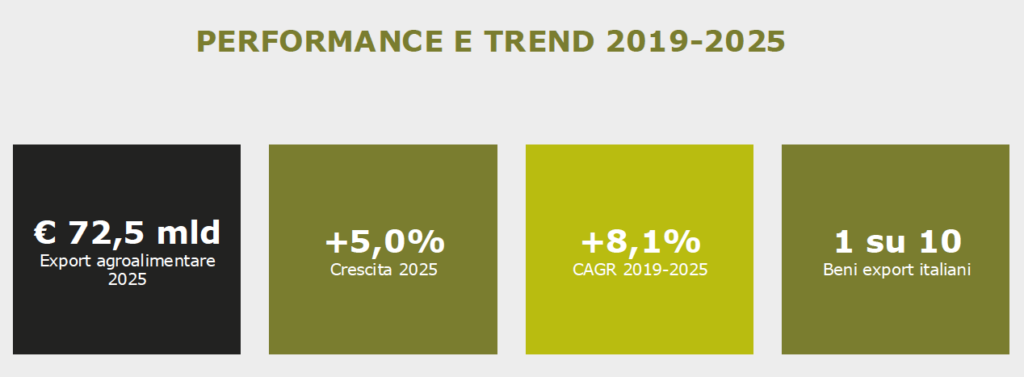
Performance and trends from 2019 to 2025. An increase of the agrifood sector pf +5% in 2025, YoY +8,1%
Uneven Performance
However, performance has been uneven. Some sectors, such as cheese and dairy products, meat, agricultural products, baked goods, and other food products, have shown very positive trends. In contrast, beverages, wine, oils, and fats have faced greater challenges3.
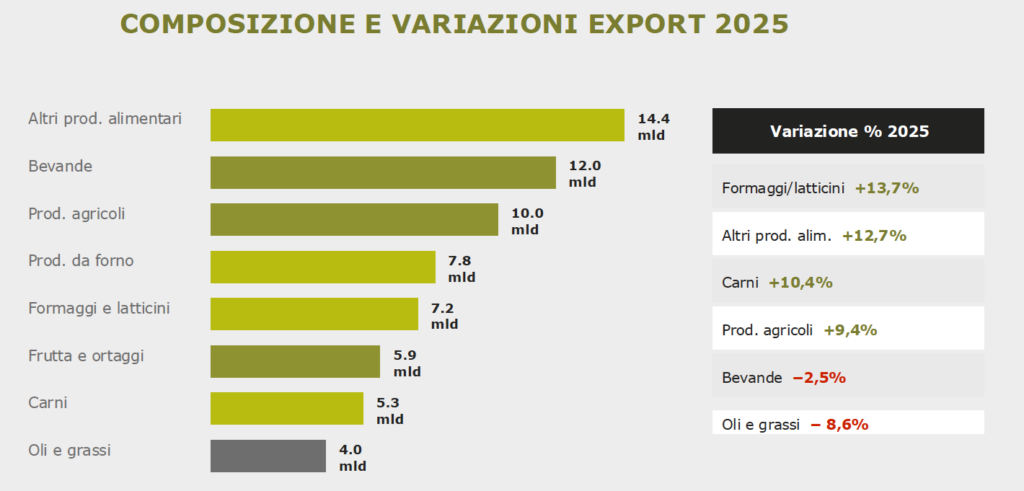
composition and variation in 2025 export. Food, drinks and agricultural products are the most exported. In 2025, an increase in export of Cheese and meat products.
The geography of exports also warrants attention. Nearby markets remain key: approximately 59% of Italian agri-food exports are destined for EU countries, while Germany, France, and the United States alone account for nearly 37% of the sector’s sales. This concentration is a strength, as it is based on established markets, but it also represents a potential risk factor.
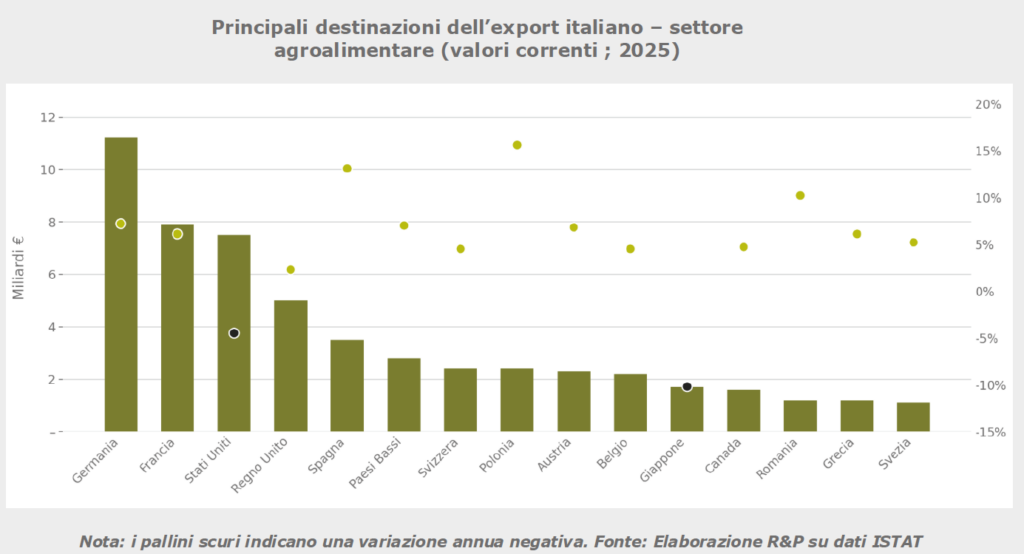
Top Destinations for Italian Exports – Agri-Food Sector (Current Values; 2025)
The less favorable trends observed in the United States—partly due to uncertainty surrounding tariffs and a slowdown in certain categories such as wine—highlight the importance of focusing on diversification. During the webinar, several growing markets were highlighted, such as Spain, Poland, Romania, the Czech Republic, and Croatia, along with less-explored but promising areas like Turkey and Morocco.
Looking ahead, particular attention should also be paid to Asia. South Korea, Vietnam, and India are examples of markets where the growth of the middle class, urbanization, the development of the hospitality sector, and a focus on quality can open up new opportunities for Italian food products.
From “Where to Export” to “Where My Product Has Real Potential”
The focus of the meeting, however, was methodological. The initial question is no longer simply, “Where should we export?” The correct question is now, “Where does my product have real, sustainable, and measurable potential?”
To answer this, data is needed—not generic industry data, but information specific to the company’s product. The starting point is the HS customs code, which allows us to move from a broad and impractical assessment of “food” to a detailed analysis.
Using the customs code, it is possible to track imports, exports, volumes, values, trends, supplier countries, average prices, market shares, and competitive dynamics. In this way, a company can determine not only whether a market is growing, but also whether that specific product category is growing and under what conditions of market access.
What We Learn from Businesses: Data, Time, and Method
A particularly useful part of the webinar was the live survey of participating companies, designed to understand how they currently choose which foreign markets to target.
When asked, “How did you choose the most recent foreign markets to target?”, the most common response was “trade shows and trade missions,” cited by 35% of participants. Next, 29% cited direct experience or personal contacts. Only 12% said they started with a structured data analysis.
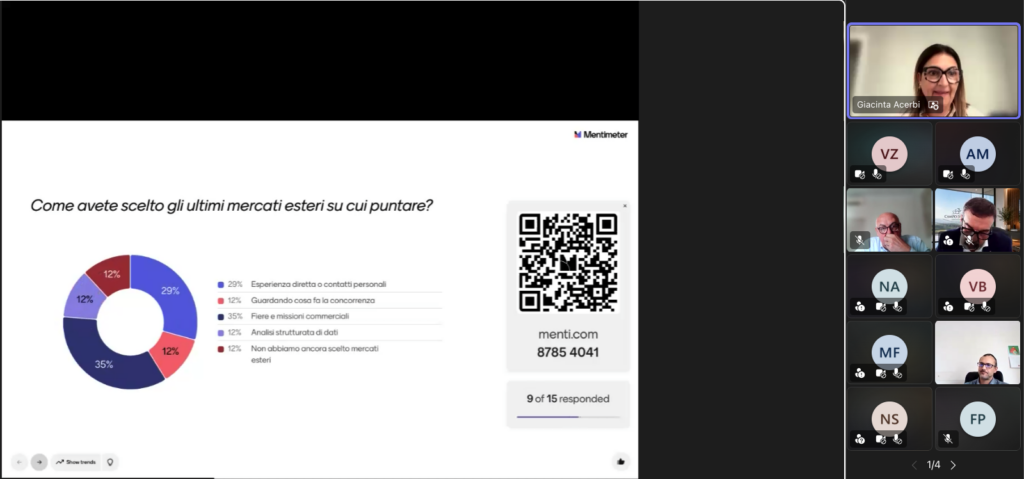
Of course, this figure has no statistical significance, but it paints a picture consistent with companies’ day-to-day experience: trade shows, relationships, contacts, and industry knowledge remain essential, but they are often not accompanied by a structured process for assessing the market’s true potential.
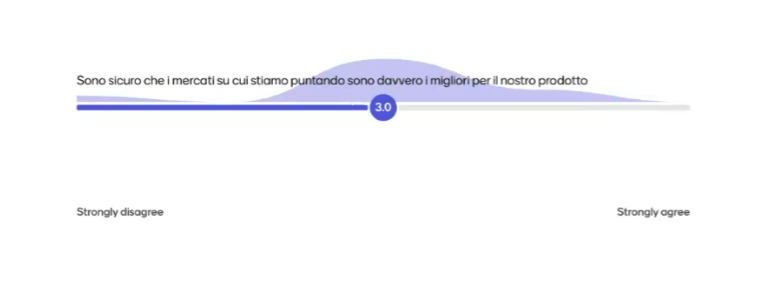
The second question asked companies how confident they were that the markets they are targeting are truly the best fit for their product. The average score was 3 out of 5: an intermediate level, indicating awareness but also a degree of uncertainty. This does not suggest a lack of confidence in the choices already made, but rather a need for tools to help validate, compare, and—when necessary—reorient those choices.
The third question, on the other hand, asked—in a single word—what was most lacking in order to choose foreign markets with greater confidence. The words that emerged most frequently were “data” and “resources,” followed by “information,” “data by category,” “strategy,” “knowledge of trends,” and “time.”
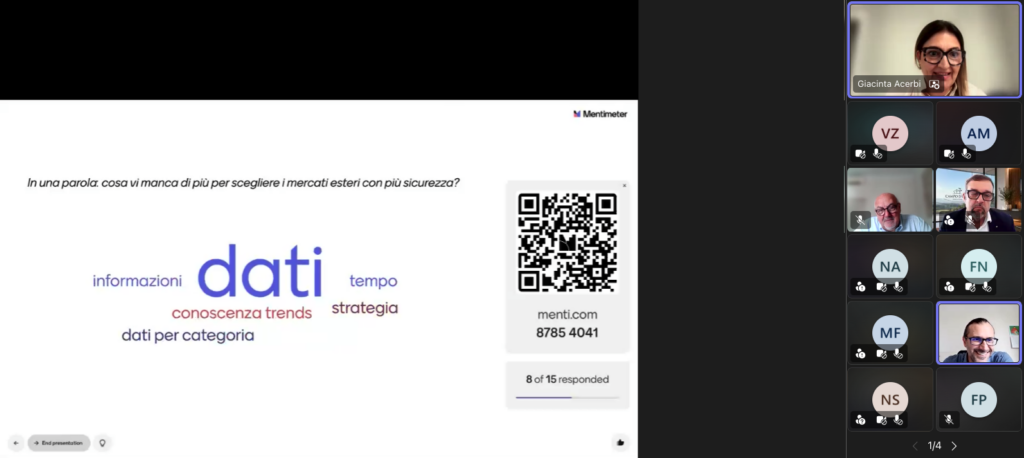
This is a significant finding: companies are no longer just asking for general information, but for data that is more relevant, more closely tied to the product, easier to understand, and more useful for business decisions.
Export Intelligence: Turning Data into Business Decisions
During the webinar, the concept of export intelligence was presented, defined as the ability to integrate various sources to transform data into operational decisions.
Customs data provides insight into who is buying, who is selling, in what volumes, and at what prices. Apparent demand allows us to estimate a market’s actual consumption by combining local production, imports, and exports. Price segmentation helps assess whether a product is positioned in the premium segment, in line with the market, or out of line with the market. Digital demand, through the analysis of online searches and keywords, offers further insights into consumer interest and market maturity.
This is not about replacing the experience of the entrepreneur or export manager. On the contrary, the data serves to make that experience more targeted. A trade show, a local contact, a spontaneous inquiry, or the presence of a competitor remain useful indicators, but they are not sufficient on their own to decide where to invest time, budget, and sales resources.
Campo d’Oro’s Story: Data and Entrepreneurial Insight
A particularly significant moment of the meeting was the testimony of Paolo Licata, CEO of Campo d’Oro, a Sicilian company with over 37 years of experience in the canned goods and specialty foods sector, operating in over 40 countries and with a direct presence in the United States.

Paolo Licata, CEO – Campo d’Oro
Campo d’Oro’s experience has confirmed the importance of data in international growth strategies: not only for identifying new markets, but also for gaining a more precise understanding of those already served, determining where to focus sales efforts, evaluating price positioning, and planning activities with greater insight.
Data does not replace entrepreneurial intuition. However, it helps distinguish between markets where one can invest more decisively and those that require greater caution, preparation, or a different timeline.
Roncucci&Partners’ Tools for Measuring Export Potential

The first is GTO™ – Global Trend Overview, a preliminary market analysis based on a product’s HS customs code. The tool processes actual customs data—in terms of value and volume—to identify the most attractive markets for Italian exports. Through a Market Score based on four dimensions—Relevance, Trend, Security, and Access—GTO™ enables companies to identify priority markets on which to focus their commercial efforts.
To learn more about GTO, download the flyer

The second is CEP™ – Country Export Potential, a vertical analysis of a target country’s potential for a specific product. CEP™ combines trade intelligence, competitive analysis, apparent demand estimates, import price segmentation, and digital demand signals.
To learn more about CEP, download the flyer
The goal is to help the company understand not only whether a market is attractive, but also what the competitive landscape looks like, what the pricing strategy might be, and which players could serve as initial business partners.
Before Entering a Market, Always Assess Its True Potential
The message that emerged from the webinar is clear: growing abroad is possible, but it requires a systematic approach. For food companies, choosing a market cannot be based solely on intuition or a fleeting opportunity. It must become a structured process, based on verifiable, comparable, and actionable information.
Because before entering a market, the key is not just to determine whether that country is attractive. The key is to determine whether it is attractive for that specific product, at that specific time, at that specific price, and with that specific strategy.
If your company wants to evaluate new foreign markets for a specific food product, Roncucci&Partners can support you with export analyses based on customs data, apparent demand, pricing, competitive positioning, and digital market signals.
Federico Rubini & Giacinta Acerbi
Related Articles:
- https://www.ansa.it/canale_terraegusto/notizie/ mondo_agricolo/2026/05/11/zoppas-export-agroalimentare-record-nel-2025-a-725-miliardi-5_56e842ad-4728-490e-9299-46bc34d7a7e3.html
- https://finanza.repubblica.it/News/2026/05/06/agroalimentare_italiano_export_a_72_5_miliardi_nel_2025_asia_nuovo_motore_di_crescita-63/
- https://www.ansa.it/sito/notizie/economia/pmi/2026/05/06/sace-vietnam-corea-del-sud-e-india-nuovi-mercati-per-agroalimentare_9d8755dd-567e-42ef-b17f-e0ab37e89257.html