
China 2025: Tariffs, Growth, and Made in Italy Agrifood

China is not an easy country to operate in; that’s why it needs to be understood.
With these words, Mario Boselli, President of the Italy China Council Foundation (ICCF), opened the presentation of the first part of the Annual Report prepared by the Foundation’s Study Center, now in its 16th edition.
Every year, the report provides a detailed analysis of the economic and political dynamics of China, one of the key players on the global stage.
The current climate of trade instability and the unpredictability of U.S. tariffs are leading to a recalibration of relations between China and the European Union. This creates the need to understand and identify arising opportunities, especially for Italian companies, with a particular emphasis on the agrifood sector, the main thematic focus of this year’s edition.
2025: A Pivotal Year
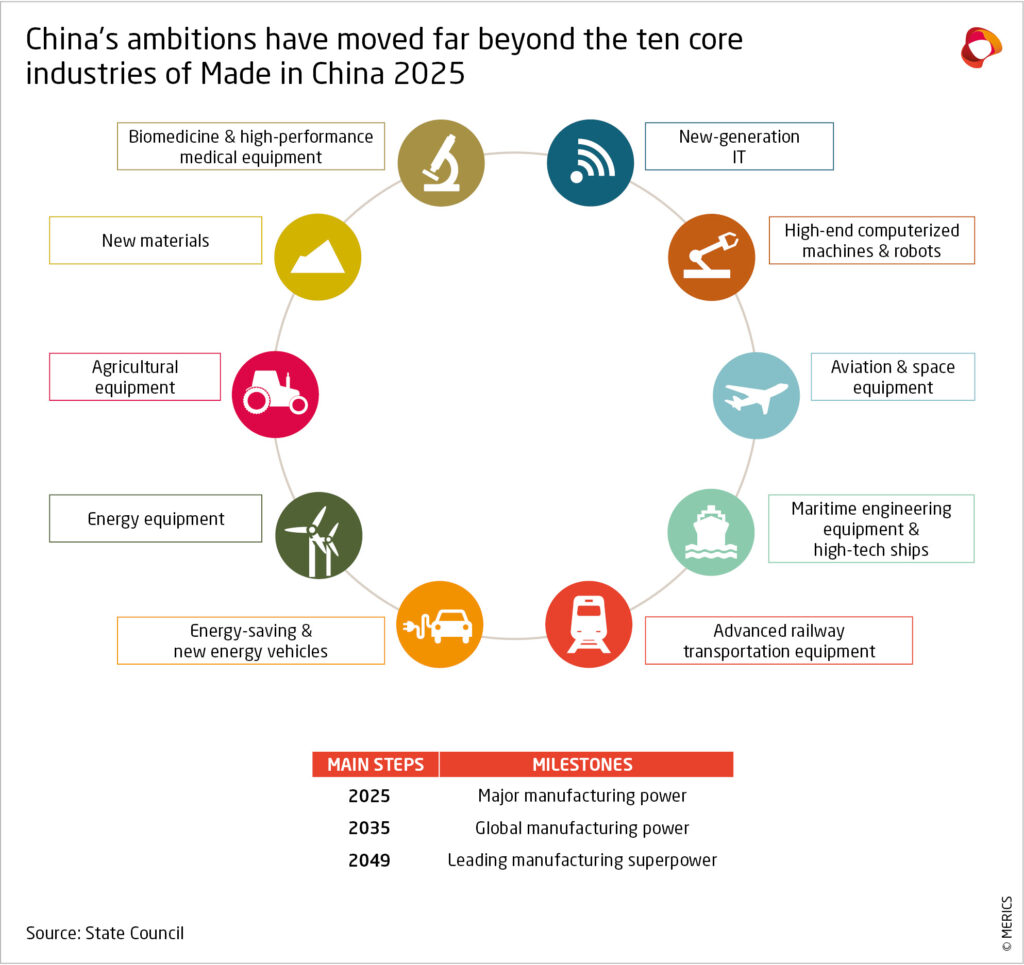
The year 2025 marks a decisive moment for two major Chinese government programs: the 14th Five-Year Plan and Made in China 2025. These initiatives set ambitious goals, such as reducing dependence on foreign supply chains, particularly in technology and energy, and transforming China into a manufacturing powerhouse recognized for the quality of its production.
Currently, China has achieved 86% of the targets set. In areas such as artificial intelligence and electric vehicles, it has emerged as a global leader. In renewable energy, it now produces over 80% of the world’s photovoltaic panels. It has also made notable progress in key sectors like advanced semiconductor manufacturing, robotics, and aerospace, though it still struggles to achieve full independence from foreign suppliers in these areas.
China Keeps Growing, But…
China’s economic growth remained steady at 5% in 2024 and rose to 5.4% in the first half of 2025. However, there are several critical challenges.
Despite its success, difficulties persist. Growth continues to be heavily export-driven, with China maintaining trade surpluses across all global regions. But recent history shows that excessive reliance on exports carries inherent risks.
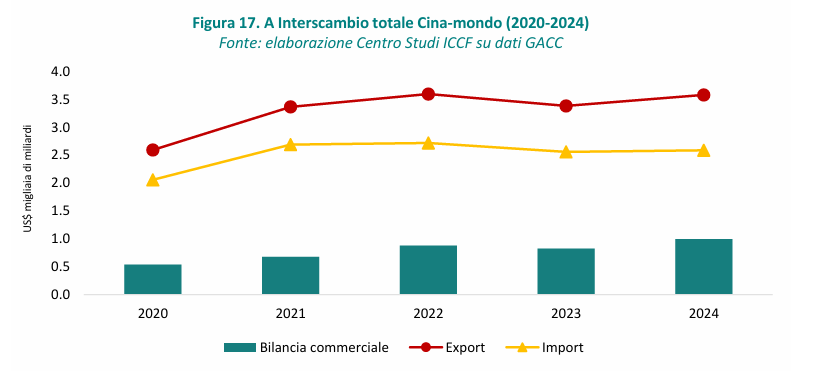
Total trade between China and the world (2020-2024)
For this reason, the government is pushing policies to boost domestic consumption. Despite a reported 5% growth, consumer spending remains relatively low compared to the country’s potential. This could further fuel deflationary pressures, given that internal demand remains weak relative to production capacity.
Another key issue is the fragility of the real estate sector, historically a major contributor to GDP. The sector remained in contraction throughout 2024 but has shown modest signs of recovery, thanks in part to falling commercial residential property prices.
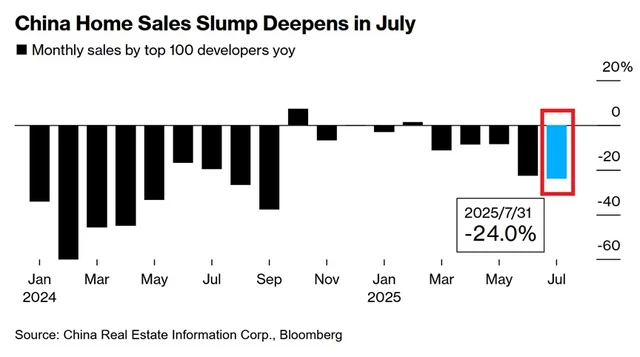
The stability of China’s economic growth will depend not only on how the government addresses these challenges, but also on external factors that are now all too familiar.
And What About Italy?
U.S. tariff policy has undeniably reshaped global trade balances. China is strengthening ties with its top trading partner, ASEAN, while maintaining relations with the European Union, which remains its second-largest trade counterpart. Germany, the Netherlands, and France lead the pack among EU countries.
Italy ranks as China’s fourth-largest trading partner in Europe and 24th globally. In 2024, Italy’s trade deficit with China widened compared to 2023, with imports from China growing faster than exports to the Chinese market. Figure 26 illustrates the main Chinese imports from Italy.
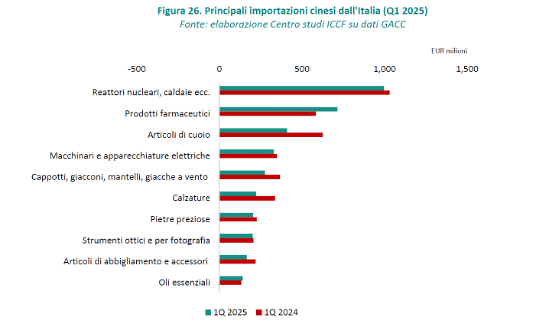
Main Chinese imports from Italy
Beyond trade, 2024 marked a year of renewed Italy–China relations. Several high-level meetings took place, including official visits by Prime Minister Giorgia Meloni and President Sergio Mattarella.
During the Prime Minister’s visit, a new Three-Year Action Plan (2024–2027) was signed, aimed at strengthening bilateral cooperation in areas such as economics, technological innovation, education, sustainability, healthcare, and cultural exchange.
Why Agrifood?
One particularly significant finding in this year’s report is the strong performance of Italy’s agrifood sector in China. In 2024, Italian food exports to China grew by 17.3%, likely driven by the growing reputation of Made in Italy products and rising local demand.
Although China is one of the world’s largest agricultural producers, it still relies heavily on imports to meet internal demand. As shown in Table 4, China mainly imports meat, fresh and shelled fruit, grains, and vegetable oils.
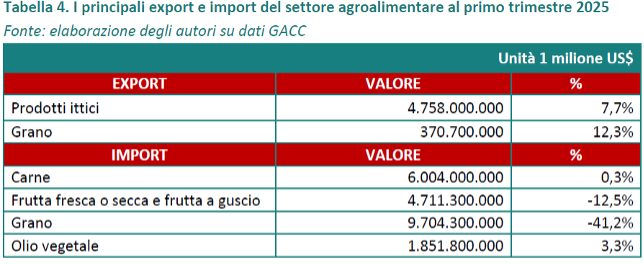
The main exports and imports in the agri-food sector in the first quarter of 2025
China represents a vast and dynamic market for Italian agrifood exports, but not without challenges: infrastructure disparities, complex regulatory frameworks, and limited protection for foreign investment all pose potential obstacles. The impact of U.S. tariffs on global value chains should also not be underestimated.
In conclusion, the Chinese market is broad, diverse, and complex, but full of potential for those who know how to navigate it. For the past 25 years, Roncucci&Partners has been supporting Italian companies in tackling complex markets, fostering sustainable international growth.
Related articles: