
A New Era of Partnership: EU and India Seal Historic Trade Agreement
How the ‘Mother of All Deals’ Creates a Two-Billion-Person Free Trade Zone
In a moment of profound geopolitical significance, India and the European Union concluded negotiations on a comprehensive free trade agreement on January 27, 2026, marking the culmination of nearly two decades of diplomatic efforts. The deal, announced during a historic visit by EU leaders to India’s 77th Republic Day celebrations, creates the world’s largest bilateral free trade zone and signals a fundamental realignment in global economic partnerships.
A Symbolic Visit Amid Changing Times
The timing and symbolism of the agreement’s announcement could not have been more powerful. On January 26, 2026, European Commission President Ursula von der Leyen and European Council President António Costa attended India’s Republic Day parade as chief guests, becoming the first dual chief guests since 2018. Their presence at the grand spectacle at Kartavya Path, alongside Prime Minister Narendra Modi, underscored the deepening ties between the world’s largest democracy and the European bloc.
The following day, as India and the EU formally concluded their trade negotiations, von der Leyen described it as the “mother of all deals,” emphasizing that it sends “a signal to the world that rules-based cooperation still delivers great outcomes.” Modi echoed this sentiment, stating that the partnership would “strengthen stability in the international system” during a time of global turmoil.
The Deal at a Glance: Unprecedented Scope and Scale
The EU-India Free Trade Agreement represents India’s largest and most comprehensive trade accord to date. Covering goods, services, and investments across the EU’s 27 member states and India’s population of 1.45 billion, the agreement encompasses approximately 25 percent of global GDP and one-third of global trade.
According to EU officials, tariffs on 96.6 percent of EU goods exports to India will be eliminated or reduced, while the EU will liberalize 99.5 percent of its tariff lines on goods imported from India over seven years. Overall, 99.5 percent of bilateral trade will benefit from some form of tariff concession.
Key Numbers
| Metric | Value |
| Population covered | 2 billion people |
| Share of global GDP | 25% |
| Current bilateral trade (2024) | €120 billion in goods |
| Trade target by 2030 | $200 billion |
| Annual tariff savings (EU products) | €4 billion ($4.74 billion) |
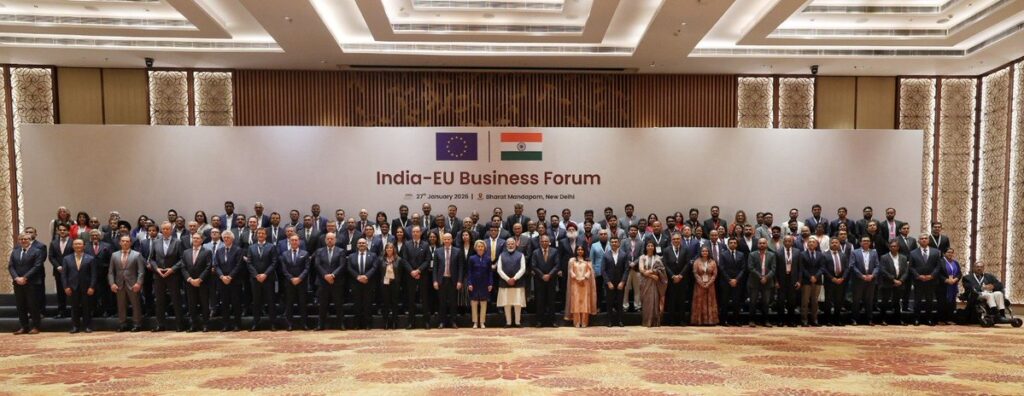
India-EU Business Forum
Winners Across Industries
European Exporters
For European businesses, the agreement opens unprecedented access to one of the world’s fastest-growing markets. India currently maintains some of the highest industrial tariffs among major economies, averaging above 16 percent. The trade deal will dramatically reduce or eliminate these barriers across key sectors.
The automotive industry stands to gain significantly. Indian tariffs on European vehicles will plummet from 110 percent to as low as 10 percent, albeit subject to quotas of 250,000 vehicles annually. Car parts will eventually become tariff-free, providing European manufacturers access to the world’s fastest-growing large automotive market.
Chemical exports, currently valued at €3.2 billion and facing tariffs up to 22 percent, will see most duties scrapped immediately upon the agreement’s entry into force. Pharmaceutical exports of €1.1 billion, currently subject to 11 percent tariffs, will become fully duty-free over five to seven years. Machinery tariffs of up to 44 percent will be mostly eliminated.
Europe’s premium food and beverage sectors will also benefit substantially. Wine tariffs will drop sharply from 150 percent to between 20 and 30 percent. Spirits will see reductions to 40 percent from as high as 150 percent, while beer tariffs will fall from 110 percent to 50 percent. Perhaps most dramatically, olive oil will enjoy complete tariff elimination, down from up to 45 percent.
Indian Exporters
For India, the agreement provides critical relief at a time when New Delhi faces the impact of steep U.S. tariffs. Indian labor-intensive sectors stand to benefit most significantly from preferential EU market access.
Textiles, apparel, marine products, leather, footwear, chemicals, plastics, sports goods, toys, gems, and jewelry will enjoy zero-duty access once the agreement takes effect. These goods, accounting for $33 billion in current exports, previously faced EU tariffs ranging from 4 to 26 percent. India’s Commerce and Industry Minister Piyush Goyal indicated that the textile sector alone could create six to seven million jobs, making it particularly crucial given that textiles represent India’s second-largest employer after agriculture.
Beyond Tariffs: Services, Mobility, and Defense
The agreement extends well beyond traditional goods trade. EU service providers will gain privileged access to India’s rapidly growing services economy in key areas such as financial and maritime services. Trade in services between the EU and India reached €59.7 billion in 2023, up from €30.4 billion in 2020.
A separate framework agreement addresses labor mobility, providing for temporary entry and stay of professionals, including business visitors, intra-corporate transferees, and contractual service suppliers. This arrangement recognizes the increasing importance of skilled worker mobility in the modern global economy.
Perhaps most notably, India and the EU agreed on a framework for deeper defense and security cooperation, signaling that their partnership transcends purely commercial considerations and reflects shared strategic interests in an increasingly multipolar world.
A Deal Born of Geopolitical Necessity
While the EU-India trade negotiations began in 2022, recent geopolitical developments provided crucial momentum for their conclusion. The agreement arrives at a moment when both parties face significant trade tensions with the United States.
President Donald Trump’s aggressive trade policies, including 50 percent tariffs on Indian goods and threats of punitive measures against European allies over disagreements regarding Greenland, have accelerated both India’s and the EU’s search for alternative partnerships. Trade analyst Ajay Srivastava characterized the agreement as creating a stable commercial corridor between two major markets at a time when the global trading system is fragmenting.
For the European Union, the deal represents the latest element in Brussels’ strategy of diversification under the banner of strategic autonomy. Over the past year, von der Leyen has signed agreements with Japan, Indonesia, Mexico, and South America, seeking to reduce dependence on the U.S. market. The India agreement is by far the most significant of these arrangements.
Former Indian diplomat Anil Trigunayat described the timing as excellent, noting that unlike 20 years ago, India now has the economic capacity to work together with the EU as a more equal partner. The agreement reflects India’s growing confidence as a major economic power and its willingness to embrace deeper international integration.
Challenges and Concerns
Despite its sweeping scope, the agreement is not without limitations and concerns. Indian carmakers expressed anxiety about increased European competition, with shares dipping approximately 1.6 percent following the announcement.
India continues to seek improvements in tariff-free steel export quotas, with negotiations expected to conclude by June 30. Under current terms, India would be allowed to export 1.6 million tonnes of steel to the EU duty-free annually, only about half its present export volume. Additionally, the EU has not granted India an exemption from its Carbon Border Adjustment Mechanism, which taxes carbon-intensive goods such as steel, cement, and fertilizer.
The final draft must still undergo legal scrutiny in Brussels and New Delhi and may not become fully operational until 2027, according to trade economist Biswajit Dhar. However, Indian officials have expressed confidence that significant portions of the agreement could enter into force during 2026.
Employment and Economic Projections
According to the European Commission, EU trade with India already supports approximately 800,000 jobs across the bloc. The agreement is expected to reinforce employment in manufacturing, services, and supply chains as trade volumes expand.
The Commission estimates that EU goods exports to India could potentially double by 2032. Given that bilateral trade in goods reached €120 billion in 2024, with an additional €60 billion in services, this projection suggests the agreement could add hundreds of billions in annual trade value over the next decade.
For India, the agreement provides crucial support for labor-intensive manufacturing at a time when these sectors face pressure from elevated U.S. tariffs. Sonal Varma, chief economist for India and Asia ex-Japan at Nomura, noted that the deal should boost India’s export competitiveness in sectors currently under strain due to higher American tariffs.
Looking Forward: A Template for Future Partnerships
The EU-India Free Trade Agreement may represent more than just a bilateral economic arrangement. It offers a template for how major democratic economies can deepen cooperation in an era of rising protectionism and geopolitical fragmentation.
By combining substantial tariff reductions with services liberalization, labor mobility provisions, and defense cooperation, the agreement demonstrates that comprehensive partnerships can still be forged even in challenging global circumstances. The fact that it took nearly two decades to complete also underscores the complexity of modern trade negotiations and the need for sustained diplomatic commitment.
As Prime Minister Modi stated during the announcement, the agreement not only creates commercial opportunities but also demonstrates that major economies can work together based on shared values and mutual benefit. In an increasingly fragmented global order, the EU-India partnership offers a counterpoint to zero-sum trade politics and suggests that rules-based international cooperation remains viable and valuable.
The coming months will reveal whether this ambitious agreement can be successfully implemented and whether it delivers the projected benefits to businesses and workers on both sides. If successful, it may inspire similar comprehensive partnerships elsewhere and help anchor a more diverse and resilient global trading system.
Conclusion
The EU-India Free Trade Agreement represents a watershed moment in international economic relations. By creating a two-billion-person free trade zone encompassing a quarter of global GDP, the deal fundamentally reshapes trade patterns between Europe and Asia. Its announcement during India’s 77th Republic Day celebrations, with European leaders as honored guests, symbolizes the deepening strategic partnership between the world’s largest democracy and the European bloc.
As von der Leyen aptly described it, this is indeed the mother of all deals, one that could define economic cooperation between democracies for decades to come.