

The Serbia Investment Compass is a valuable forum for analyzing, from an operational perspective, Serbia’s investment climate, FDI trends, reforms, incentives, and emerging financial instruments. At a time when the Balkans have returned to the center of nearshoring and diversification strategies, the event offered concrete insights for companies and investors looking at the Serbian market in the 2025–2027 timeframe.
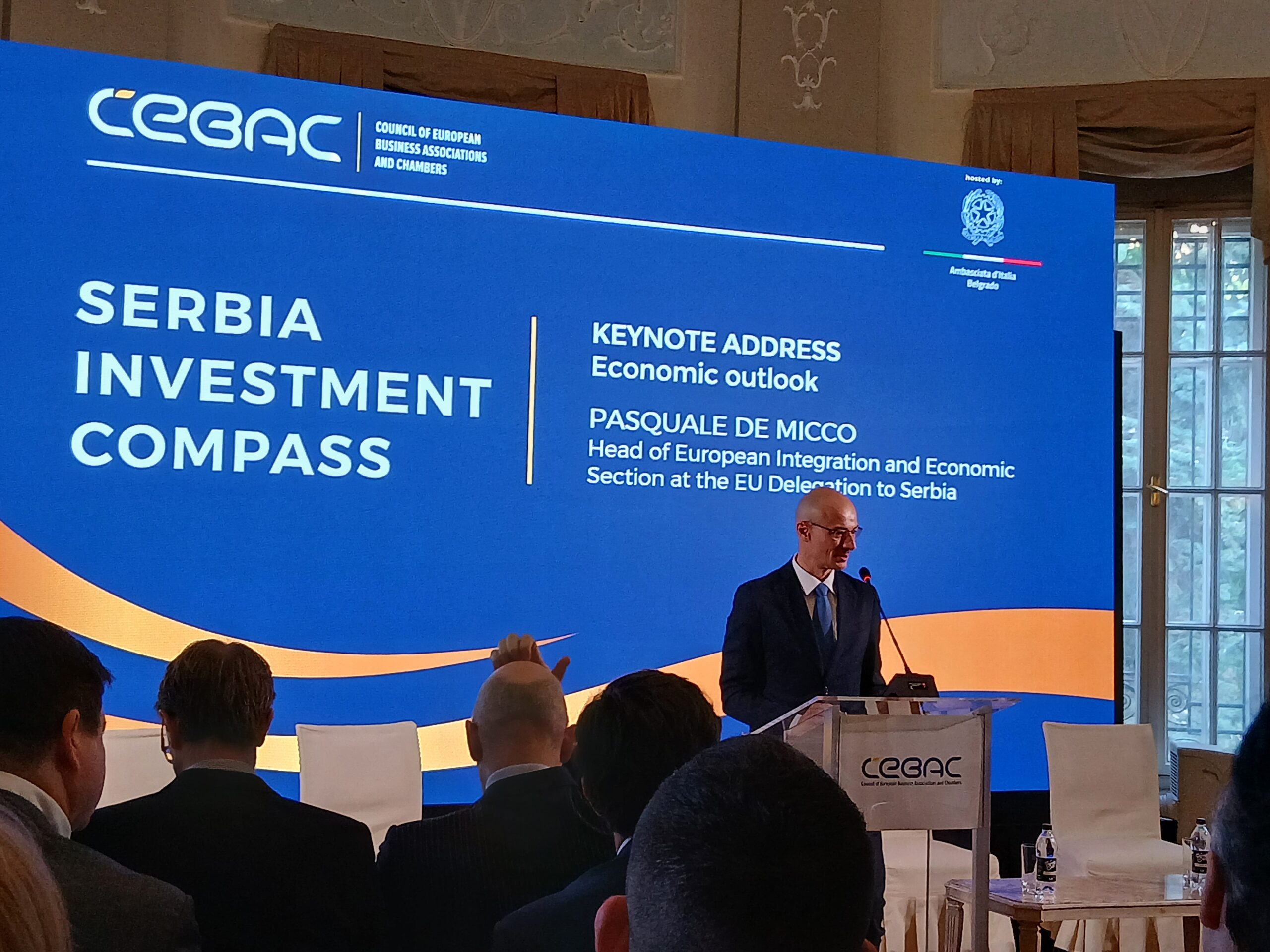
The “Serbia Investment Compass“, organized by CEBAC (Council of European Business Associations and Chambers), was held on December 4, 2025, at the Residence of the Italian Ambassador to Serbia, Luca Gori.
The event took place against a backdrop of global economic uncertainty and domestic challenges within Serbia, particularly the delicate phase affecting the national energy sector.
The initiative brought together institutional representatives, business associations, investors, and Serbian and European stakeholders active in the economic and financial sectors.
Institutional Opening Remarks
One figure that helps contextualize Italy’s presence in Serbia is its existing economic footprint: with nearly €4 billion in investments and approximately 1,200 registered Italian companies, Italy is Serbia’s third-largest trading partner.
During the opening session, a key point also emerged: Serbia’s ability to consolidate a new cycle of growth will depend on the combination of contextual stability, reforms, human capital, and access to more diversified financial instruments.
EU Economic Outlook: Investment Dynamics and Reform Prospects
De Micco recalled that the European Union’s latest Enlargement Report shows a slowdown in Serbia’s reform path. Nevertheless, the country continues to be valued for the strength of its economic governance—a solid foundation on which to build in the years ahead.
One of the central issues highlighted was the decline in foreign direct investment: in the first nine months of the year, FDI recorded a 50% decrease compared to 2024.
The analysis identified both external and internal factors.
External Factors
Among the external drivers affecting exports and investments, the European macroeconomic environment and international tensions remain decisive. At the same time, regional competition to attract industrial and technological projects has intensified. For Serbia, the challenge lies in turning its geographic position and manufacturing base into a structural advantage, also through more modern infrastructure and logistics.
Internal Factors
On the domestic front, recurring themes included the quality and stability of the regulatory framework, authorization timelines, the ability to retain talent, and the scaling of technical skills. It is precisely this combination—clear rules, human capital, and financial instruments—that underpins much of the country’s credibility in the eyes of industrial and financial investors.
1) FIRST PANEL – Investment Trends
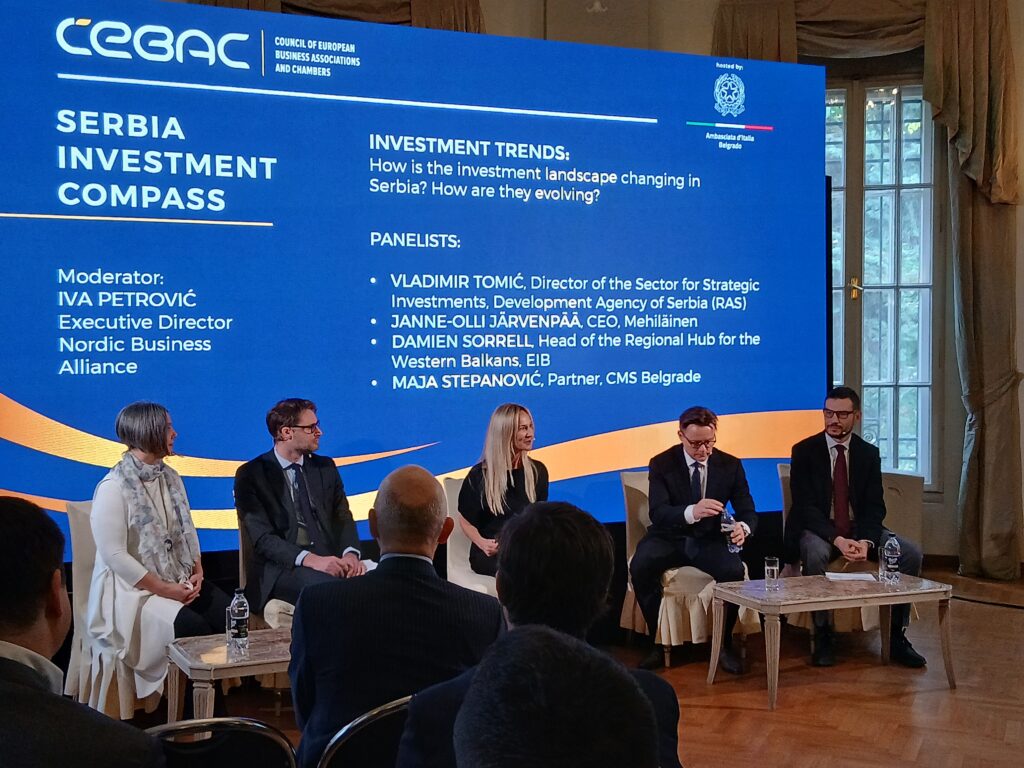
The panel focused on the evolution of investments over the past 3–5 years.
Vladimir Tomić, representing RAS (Development Agency of the Republic of Serbia), highlighted three key trends:
- industrial transition, with growth in sectors related to electric mobility;
- a geographical shift among investors, from EU dominance to a growing Asian presence;
- the relatively limited size of the Serbian market, which influences location decisions.
Maja Stepanović also emphasized the potential of investments in research, development, and education—critical factors in transforming Serbia into an intellectual property hub.
The Mehiläinen–MediGroup Case
Janne Ollijärvenpää described the merger as a long-term strategic investment, based on strong integration with local human capital. The group, founded in the early 1900s, bases its investments on 20–30-year projections and sees significant potential in the Balkans despite temporary challenges.
New Incentives and Attractive Sectors
The focus of future incentives is increasingly shifting toward more “qualitative” sectors, where technology, services, and sustainability play a central role. At the same time, major events and infrastructure programs can act as catalysts for indirect investment. EXPO 2027 Belgrade, according to the Bureau International des Expositions, is expected to attract over six million visitors and more than 130 participating countries over three months.
Damien Sorrel noted that the European Investment Bank’s main financeable projects are concentrated in infrastructure, energy transition, innovation, and education—primarily in collaboration with the public sector.
2) SECOND PANEL – New Investment Instruments
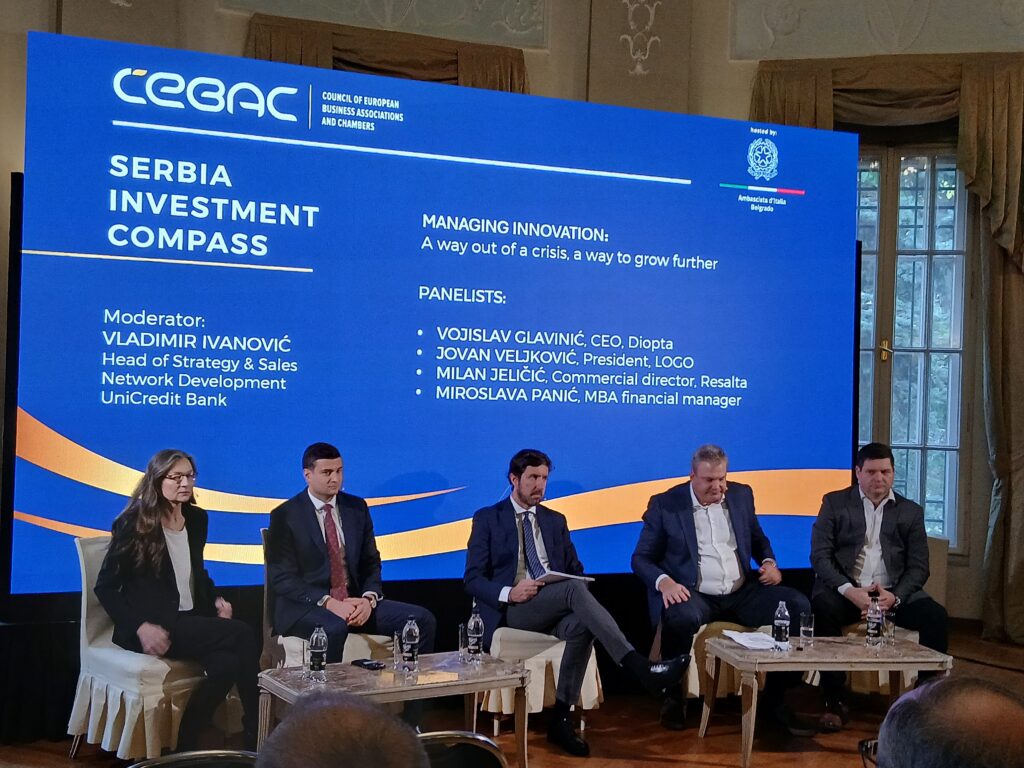
Speakers: Miroslava Panić (MBA financial manager), Jovan Veljković (LOGO), Milan Jeličić (Resalta), Vojislav Glavinić (Diopta)
The second panel addressed the evolution of financing instruments for Serbian companies.
Banks—particularly Intesa and UniCredit—are introducing minibonds targeted at SMEs, following a model already well established in Italy.
The Diopta Experience
Glavinić explained the decision to use minibonds as an alternative to traditional bank credit, highlighting advantages such as:
- no collateral requirements,
- lower costs,
- fixed interest rates not linked to Euribor,
- a faster and more flexible process.
Corporate Bonds for Growth
Veljković described LOGO’s issuance of a state-supported corporate bond, driven by the need for new capitalization to support growth and the transition from a family-owned model to a corporate structure—facilitated by subsidies specifically designed to support such transitions.
Green Bonds and Energy Transition
Jeličić explained that many Serbian companies must adapt to ESG requirements in order to operate with EU partners. Green bonds therefore become a useful tool to:
- finance energy efficiency,
- comply with new environmental regulations,
- support competitiveness in European markets.
- Digital Asset e tokenizzazione
The Development of Digital Assets in Serbia
According to the 2021 law, both Serbian and foreign companies can issue tokens linked to real assets, while Serbian investors can purchase digital assets abroad under the supervision of the National Bank and the Securities Commission, as explained by Miroslava Panić.
Advantages:
- the ability to finance non-bankable projects;
- reduced documentation requirements;
- efficient processes without intermediaries;
- lower costs compared to bank loans.
Disadvantages:
- skepticism toward blockchain infrastructure and wallets;
- higher return expectations from investors in the absence of tangible guarantees;
- lack of a regulated secondary market.
An inspiring example cited was an agricultural company—a hazelnut plantation—where each tree corresponds to a token. According to the speakers, these instruments enhance transparency, innovation, sustainability, and financial diversification.
3) THIRD PANEL – A Way Out of the Crisis, a Path to Growth
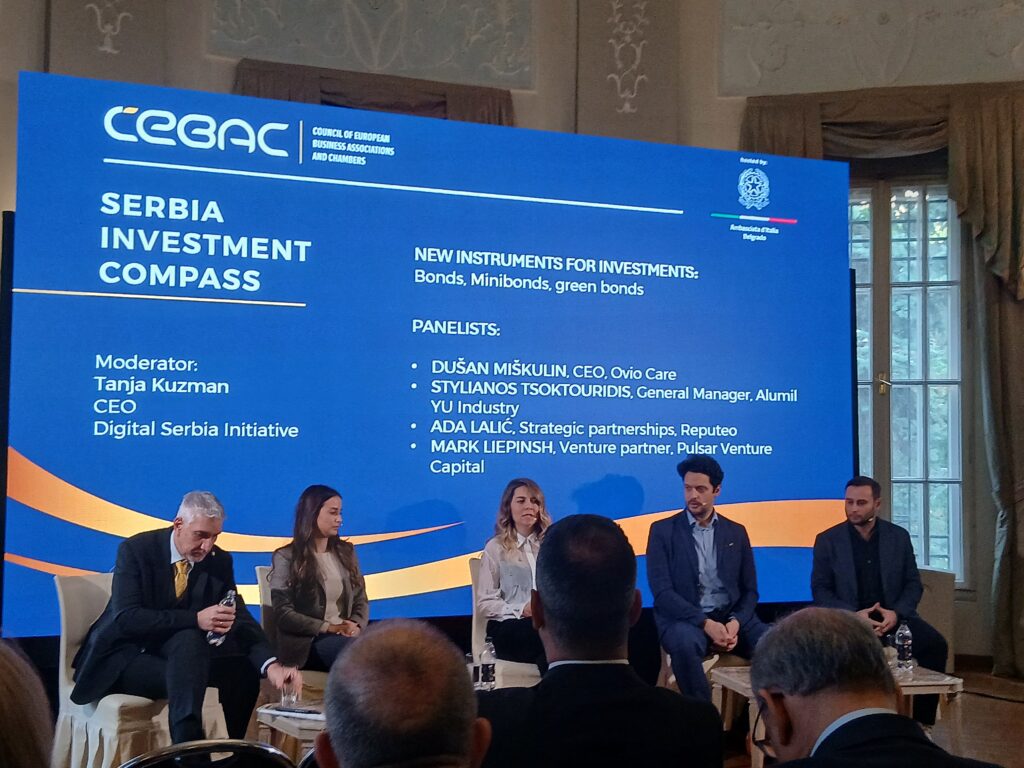
Innovation generating innovation: for the first time in Serbia, a rapid cycle is emerging in which innovation generates further innovation within just a few months.
International Cooperation in Innovation
Ada Lalić described Serbia–UK cooperation, supported by the British-Serbian Chamber of Commerce, aimed at facilitating idea exchange, mentoring, and support for Serbian startups and industrial ecosystems.
In manufacturing, as highlighted by Tsoktouridis, the focus has been on resilience and automation to strengthen supply chain resilience, respond to emissions regulations, and collaborate with local robotics and automation companies to reduce dependence on scarce labor.
Another key focus has been internal skills development: building technical skills among non-technical profiles, and non-technical skills among technical profiles—both essential to addressing future challenges.
From Data to Added Value
Mikulin illustrated how, in the case of Ovio Care—originally operating exclusively in the socio-healthcare sector—the large volume of collected psychological, sociological, and behavioral data opened up new opportunities: advanced analytics, potential applications in neuroscience, and the creation of new data-driven value models.
Regarding fintech investments, speakers observed that international investors—especially from the United States—are currently more cautious. Capital is being channeled toward fintech and technologies with measurable returns. It was also widely noted that the use of AI often remains superficial—more a marketing buzzword than a structured investment—leading investors to conduct in-depth due diligence to verify whether AI-related investments are truly foundational.
If you are evaluating business or investment opportunities in Serbia, feel free to contact us: the Roncucci&Partners team is available for discussion and to support you in defining the most suitable path for your needs.