
The Chinese Market and Companies in Emilia-Romagna: The ICCF China 2026 Report
On April 14, the Emilia-Romagna Region hosted a meeting focused on China and the prospects for Italian businesses, with a particular emphasis on the region’s manufacturing sector.
During the event, the Italy China Council Foundation (ICCF) presented the first part of the China 2026 Report, which examines the country’s economic and political landscape and the opportunities arising from the energy transition between Italy and China. The Report offers an up-to-date analysis of a market that remains strategic in terms of size, production capacity, and role in global value chains, but which today requires Italian companies to adopt a much more selective approach than in the past.
China can no longer be viewed solely as an export market. For many companies, it is also a production hub, a strategic supplier, a technology partner, and a key player in energy transition processes. For this reason, the real issue is no longer simply “entering China,” but understanding where, how, with which partners, and with what level of risk exposure.
A market that remains strategic, but that requires closer scrutiny
In the first quarter of 2026, the Chinese economy continued on a path of steady growth: GDP increased by 5%—placing it at the upper end of Beijing’s target range for the year. While this growth is more moderate than in past expansionary phases, it remains significant for international companies.
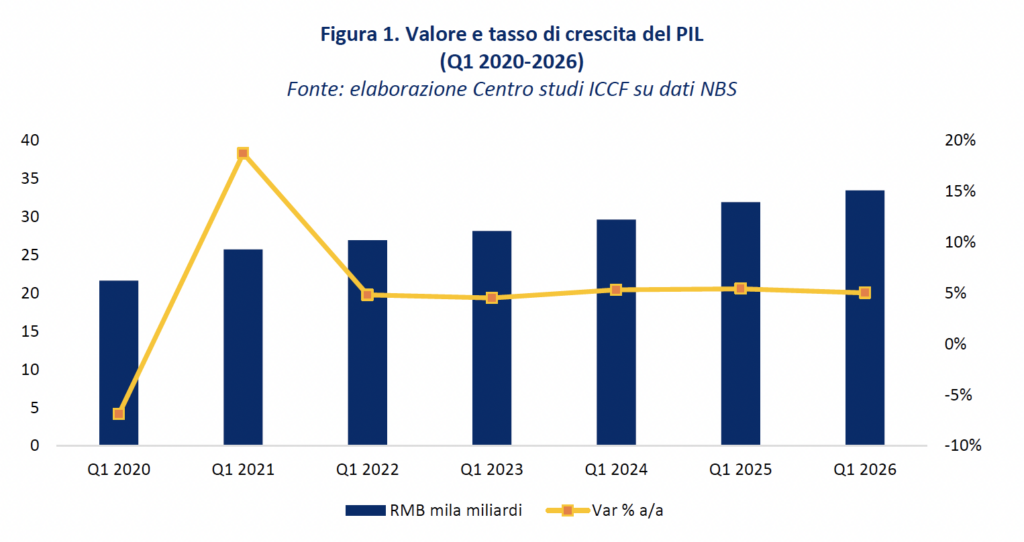
GDP value and growth rate for Q1 2020–2026. Source: China 2026 Report – Part 1, ICCF.
That said, there are still reasons for caution. Domestic consumption is showing signs of recovery, but remains constrained by a still-high propensity to save. The real estate sector continues to weigh on household confidence, while the international geopolitical landscape is creating uncertainty regarding energy costs, supply chains, and global demand.
For Italian companies, this means that China remains a market with great potential, but it cannot be approached with a one-size-fits-all approach. It is necessary to assess the sector, the product’s positioning, the most suitable province, the entry channels, the reliability of local partners, and any dependence on suppliers or customers concentrated in a single area.
In other words, the question is no longer: “Is China still an attractive market?” The correct question is: “Which part of China is attractive for my business?”.
China is Not a Single Market: the Role of the Provinces
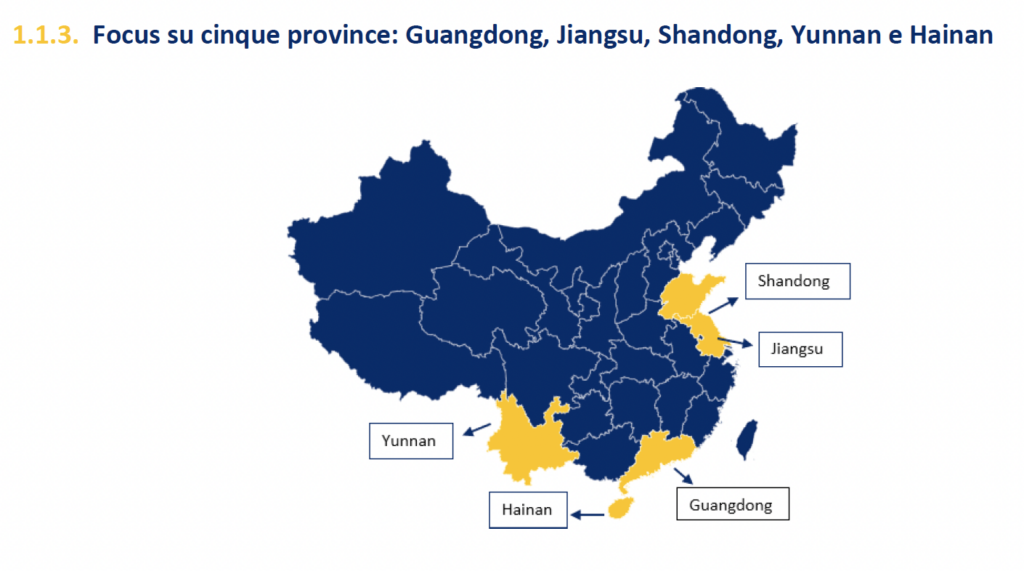
Regional focus on the provinces analyzed in the China 2026 Report: Guangdong, Jiangsu, Shandong, Yunnan, and Hainan. Source: China 2026 Report – Part 1, ICCF.
One of the most significant findings of the China 2026 Report is the importance of the regional dimension. Competitiveness in China, particularly for European and Italian companies, increasingly depends on the ability to adopt a provincial and multi-level strategy.
The most advanced coastal provinces, such as Guangdong, Jiangsu, and Shandong, continue to serve as key economic hubs.
- Guangdong offers access to advanced manufacturing supply chains, innovation ecosystems, mature consumer markets, and cross-border e-commerce infrastructure.
- Jiangsu remains an attractive destination for advanced manufacturing, mechanical engineering, chemicals, and life sciences.
- Shandong presents opportunities in the agri-food, wine, maritime, heavy machinery, and environmental technology sectors.
Further Opportunities in Yunnan and Hainan
- Yunnan has the potential to become a logistics and trade hub for Southeast Asia, as well as a key region for premium agri-food products, green energy, and hydroelectric technologies.
- Hainan, thanks to its free trade port status, can serve as a base for importing, processing, and distributing products to the mainland Chinese market.
For businesses, choosing a province therefore becomes a strategic decision. Each area has different production specializations, incentives, levels of industrial maturity, operating conditions, and regulations. An effective strategy for the Chinese market must start from this understanding.
China in the Emilia-Romagna Manufacturing Sector
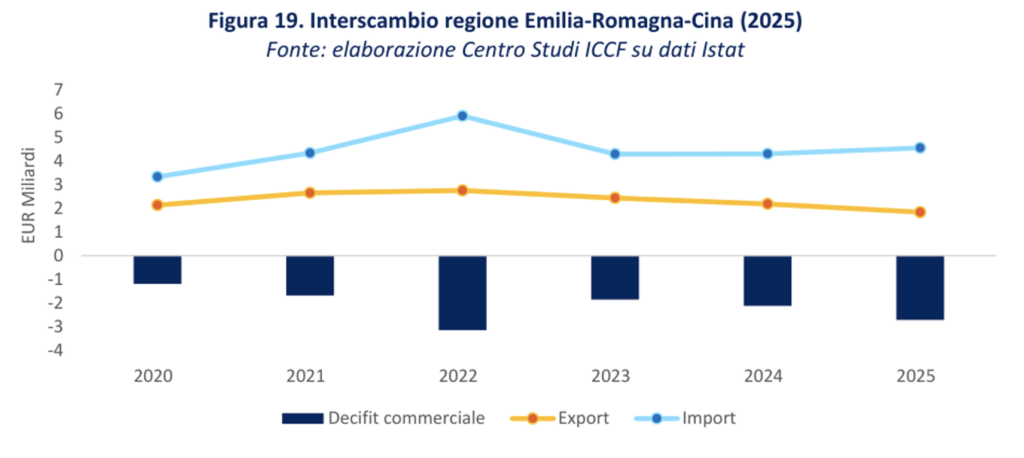
Trade between Emilia-Romagna and China: trends in exports, imports, and the trade deficit. Source: China Report 2026 – Part 1, ICCF, based on Istat data.
The contribution by Guido Caselli of Unioncamere Emilia-Romagna was particularly significant, as he highlighted the true scale of the relationship between the region’s manufacturing sector and China.
The data presented show that approximately 7,700 companies in Emilia-Romagna have ties to the Chinese market. Of these, 2,440 are exporters, 6,350 are importers, and 1,427 are involved in both import and export activities.
Relations with China therefore do not concern just a few large companies, but a broad and diverse range of businesses. However, China’s economic weight varies significantly depending on whether one looks at exports or imports.
On the export side, the Chinese market accounts for an average of 2.8% of company revenue and 11.8% of the total exports of the companies involved. On the import side, however, the dependence is much more pronounced: China accounts for 10.2% of revenue and 59.8% of total imports.
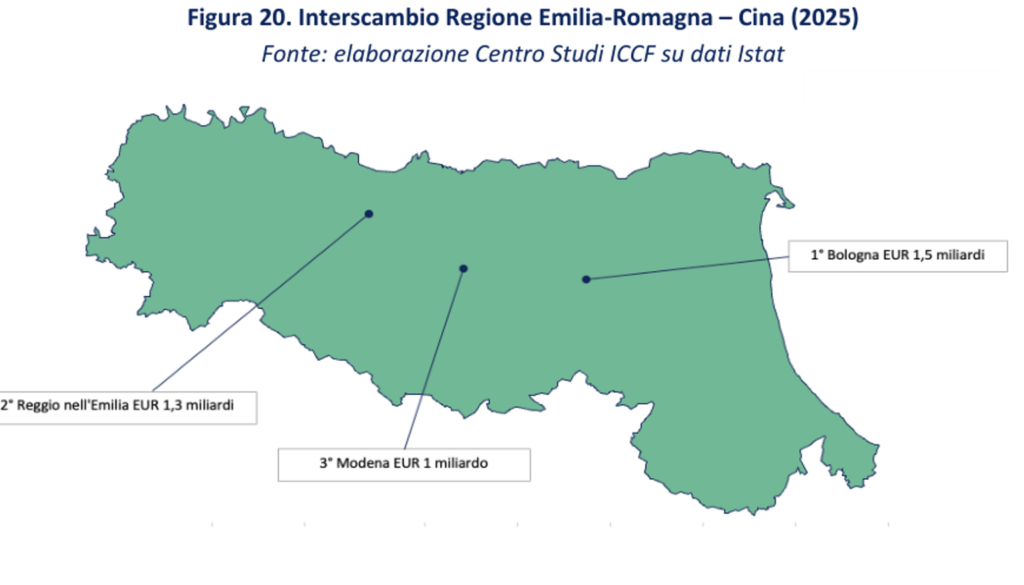
Geographical distribution of regional trade with China, with a focus on the main provinces of Emilia-Romagna. Source: China Report 2026 – Part 1, ICCF, based on Istat data.
This figure is particularly significant for SMEs. For many companies in Emilia-Romagna, in fact, China is not only a target market but, above all, a strategic supplier of components, intermediate goods, technologies, and manufactured products.
Exports, Imports, and Supply Chains: Opportunities and Interdependencies
Exports from Emilia-Romagna to China are driven primarily by the mechanical engineering and capital goods sectors.
Among the most common products are special-purpose machinery, meters, general-purpose machinery, pumps and compressors, transmission components, fluid power equipment, valves, plastic products, and automatic dosing and packaging machines.
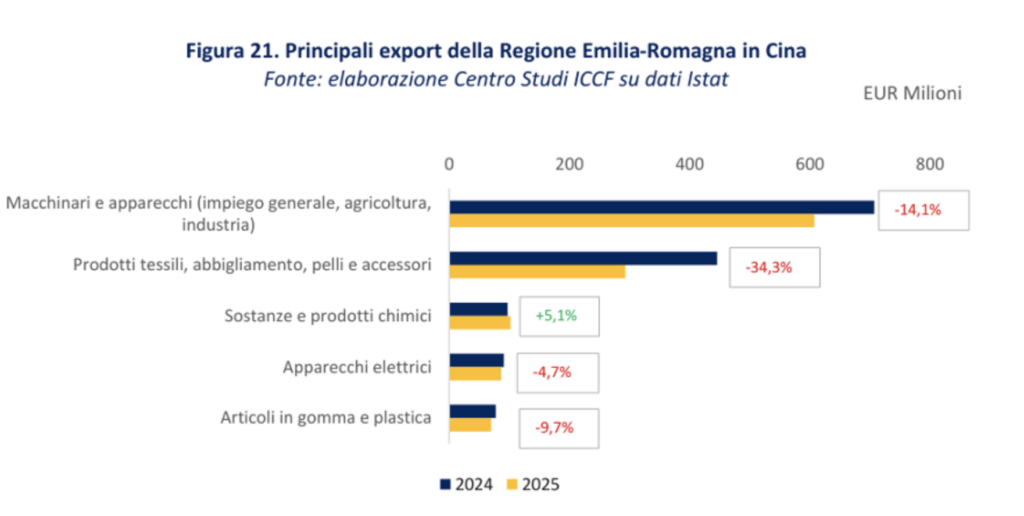
Main categories of exports from Emilia-Romagna to China. Source: China 2026 Report – Part 1, ICCF, based on Istat data.
When it comes to imports, however, China is a major source of plastic products, electrical equipment, metal goods, electric motors and transformers, computers and peripherals, pumps and compressors, travel goods, and wiring equipment.
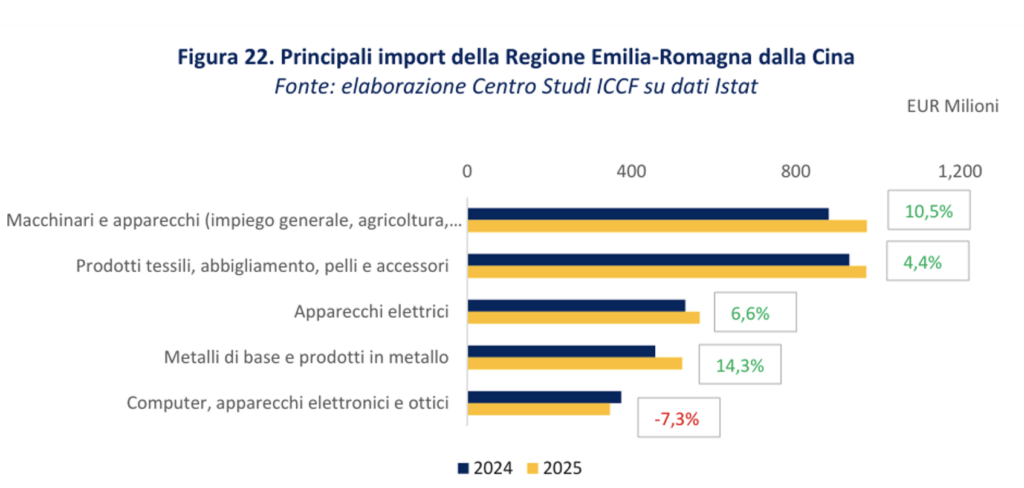
Main categories of imports from China to Emilia-Romagna. Source: China Report 2026 – Part 1, ICCF, based on Istat data.
The report also highlights that trade is no longer driven solely by a “low-cost” approach. Regional exports to China have an average value per kilogram that is well above the global average, while imports from China also demonstrate increasing quality and technological sophistication.
This means that the relationship between Emilia-Romagna and China is now structural. On the one hand, it offers opportunities for more specialized companies; on the other, it exposes the production system to risks of concentration and dependence, especially in terms of supply.
For companies that work with China, or intend to do so, it is therefore essential to carefully evaluate suppliers, commercial channels, the continuity of relationships, and possible diversification strategies.
How to Prepare for the Chinese Market
The meeting yielded a clear message: China remains a key market, but it cannot be approached with a haphazard strategy.
Companies seeking to export, import, invest, or build partnerships in China must begin with a detailed analysis of their industry, competitive positioning, and the most suitable geographic area. They must also assess the impact of geopolitical dynamics, the energy transition, shifts in consumer behavior, and growing local competition.
The Chinese market continues to offer significant opportunities for mechanical engineering, premium agri-food, fashion, design, green technologies, components, healthcare, automotive, and advanced services. However, these opportunities require preparation, consistency, and the ability to adapt.
For companies in Emilia-Romagna, which are already deeply integrated with China, the issue is no longer simply entering the market, but making their relationship with a country that remains central to global value chains more solid, informed, and sustainable.
In this process, Roncucci&Partners supports companies in analyzing foreign markets, defining entry strategies, vetting partners, and evaluating international suppliers. Even when the goal is not to sell in China but to make their supply chain more secure, a systematic approach, data, and thorough verification are essential.
China still presents opportunities. But today, more than ever, it is a market that requires in-depth understanding before investing time, resources, and business relationships.
Related Articles
https://roncucciandpartners.com/2026/04/29/safe-sourcing-fornitori-affidabili/
https://roncucciandpartners.com/2026/03/30/lo-stretto-di-hormuz-e-il-rischio-dei-chokepoints-perche-le-imprese-devono-ripensare-export-e-supply-chain/