
Q.F.D. – How to develop a new product, or service, with the necessary characteristics and realistic goals
Q.F.D., short for Quality Function Deployment, is an analytical methodology for defining the characteristics of a new product, or service, addressed to a defined market.
And so far, we can say that there is no great difference compared to what companies generally try to do when they are about to define a new product or service. What is new is that the Q.F.D. is an analytical procedure that sets out to define the objective and no longer subjective value, and thus the true value of the features and functions of the new product/service, attributing to all features a value and weight in relation to competition and market needs by resorting to all the knowledge assets in the company.
It can be said that the Q.F.D. represents a powerful and probably the most powerful analytical model for defining the “Value Proposition“; the key word is “function” (i.e., “functionality”). The focus is then on the functionality of that product or service, which must first and foremost meet the customer’s needs; it must not only be technological but must be subservient to the customer’s needs. The fundamental concept is that of “servitization.”
Mistakes not to make when developing new products or services
The definition of a new product or service may arise from the need to align with the competition, from a need to improve, from the decision to diversify or expand a product range, or even from a brilliant idea. In all these cases, in order to be sure of the validity of the project, it is appropriate and recommended to define the product plan with an analytical methodology to objectively and realistically define the characteristics, purposes, development time and costs.
Roncucci&Partners has more than once had to deal with the development of new products and/or review the features of newly launched products, witnessing the mistakes that can be made in this fundamental activity of a company’s growth and development. Such mistakes can, at best, result in longer lead times, misjudgment of costs, or partial achievement of set goals, while, at worst, they can even result in product redesign.
The most common mistakes people make are:
- start working without having defined the product plan in detail;
- not having delved into it what the competitors are offering and how our company is perceived;
- pursue projects without really knowing their costs and feasibility;
- end up having to solve downstream problems created upstream with the risk of compromising product quality.
Q.F.D. is the tool to avoid these errors. It can be argued that the Q.F.D. is the only procedure to correctly identify the functionality of the value proposition, ensure the desired quality, define realistic goals, carefully quantify costs at the design/project stage, avoid the additional costs of subsequent changes and redesigns, and finally prevent time-to-market to be extended.
Q.F.D. analysis
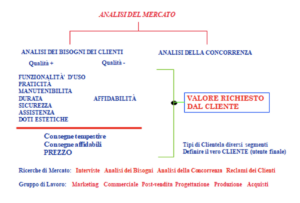
But how does a Q.F.D. analysis unfold in practice? The analysis proceeds by the following points:
- The first point is the “Voice of the Customer”, which encourages the company to define what the customer really needs.
- In the F.D. analysis, to make the “Voice of the Customer” true/valid, all functions in the company and interested in the development of the new product or service must participate, namely marketing, sales, after-sales, design, production, purchasing and logistics.
- The “Voice of the Customer” is analyzed in detail, “deployment“, otherwise it would not be possible to succeed in defining what the customer really needs.
- Then the market is analyzed, taking into account what the customer thinks of our products or services, and how competitors’ products or services are perceived.
- Finally, after having evaluated the characteristics of the product or service and compared them with the customer’s needs, we proceed to the analysis of the price that the market is willing to recognize to the new value proposition and thus define the “Product Plan.”
Schematizing the above concepts, we obtain the following scheme:
Only in this way can we succeed in giving real, objective value to the “value proposition” and proceed as confidently as possible with the investment needed to develop the new product or service.
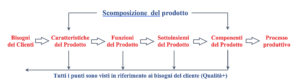
Let’s look more into the details of how in the Q.F.D. of the new product or service the “deployment” of all functions and features is developed. The method to be followed makes it possible to define a path from the careful analysis of the customer’s needs to the objective definition of the product specifications i.e., the “Product Plan” and the development of the product in its various stages, according to the following scheme:
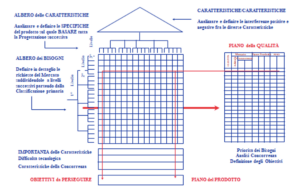
In practice, Q.F.D. analysis is developed in the form of a matrix in an XL spreadsheet.
The columns contain what is called the “product tree” where all the features of the product or service are listed, followed then by what is called the “quality plan”, which compare the competitor products and define goals.
In the rows, we have the “voice of the customer”, assigning each individual item a value in order to express a correlation between “needs” and “characteristics” to thus arrive at not only a qualitative, but also a quantitative assessment, in other words, an objective evaluation of that characteristic.
The next step is the “product plan,” that is, the design and development of the “true” features by going through all the business functions involved until the bill of materials and processing cycles are defined in order to verify that the realistically projected costs are then actually compatible with the assumed “Value Proposal.”
In the light of all these considerations, the importance of proactive discussion among all business functions involved in the implementation of the new product seems clear and it must take place at the definition stage. In fact, in this way each function can contribute to the success of the project, avoiding the need to resort to a product that has already been designed, is in an advanced state of development, or even has already been launched for modifications, improvements, redesigns etc..
The figure below schematically demonstrates the above:
Luigi Travaglia
Note: We would like to thank Eng. Tesi, consultant at Roncucci&Partners, and one of the national leading experts on Q.F.D., who kindly provided the necessary material for this article.