
Japan and South Korea: Why Italian SMEs Should Focus More on Asia’s Premium Markets

There are markets that Italian SMEs are familiar with and actively engage in, but have not yet fully capitalized on. Japan and South Korea fall into this category: two mature, high-income economies with favorable trade agreements with the European Union and a structural demand for high-quality, certified, and well-positioned products.
These are markets where “Made in Italy” is already well-known, appreciated, and, in many sectors, regarded as the gold standard. Yet, relative to their potential, they remain underutilized by many Italian companies.
This was the focus of the webinar held on June 18, 2026, co-organized by Roncucci&Partners and BPER Banca: not a presentation of exotic and distant markets, but a practical discussion on how to enter, grow, and consolidate one’s presence in two contexts where Italy already enjoys credibility and can further strengthen its position.
An Established Presence to Be Strengthened Through a More Strategic Approach
The numbers speak for themselves. Trade between Italy and Japan is projected to reach 12.3 billion euros in 2025, with a trade surplus of 4.4 billion dollars in Italy’s favor (approximately 3.8 billion euros). There are 166 Italian companies operating in Japan, with an estimated local revenue of around 3 billion euros.
Trade with South Korea amounts to 10.9 billion euros, with 120 active companies and a trade surplus of 924 million. These are not, therefore, markets yet to be discovered, but markets to be approached with greater method, greater consistency, and an entry strategy that is truly aligned with their rules.
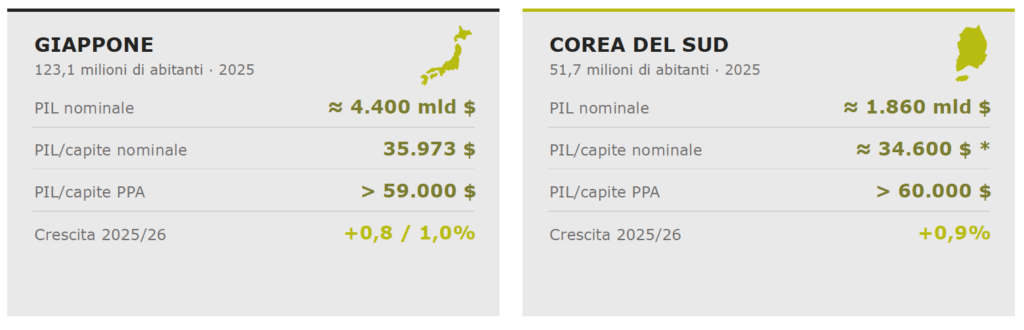
Japan and South Korea’s GDP
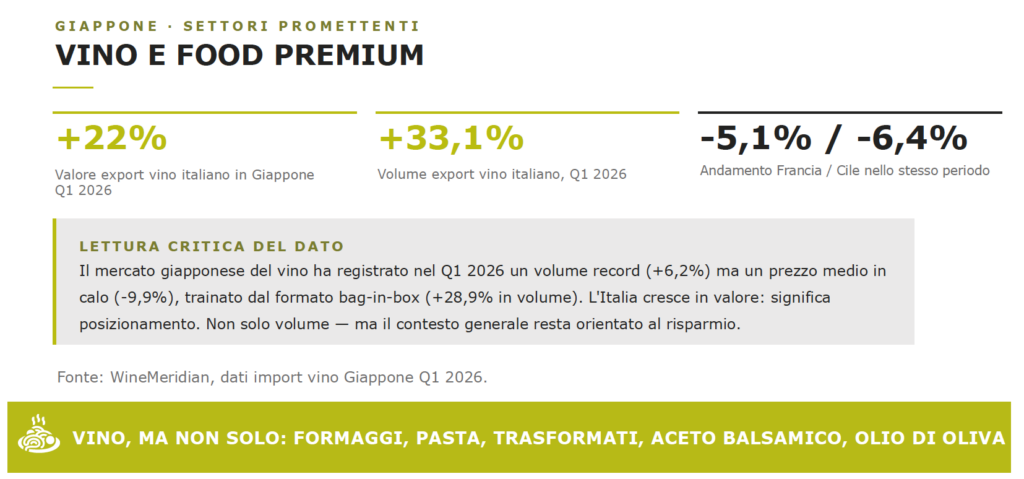
In some sectors, Italy already holds a leading position. In 2024, Italy was South Korea’s top supplier of leather goods, accounting for 33.6% of the sector’s total imports. In the wine sector, during the first quarter of 2026, Italian exports to Japan grew by +22% in value and +33.1% in volume, while France and Chile saw declines. In the machine tool sector, South Korean imports of Italian machinery rose by +16.93% year-over-year in the first half of 2025.
These figures do not refer to distant and inscrutable markets. They refer to markets where Italy has already built a reputation and where there is real opportunity for companies that choose to operate with a clear positioning, suitable partners, and a medium-term vision.
A Costly Mistake: Treating Them as If They Were the Same Market
Japan and South Korea are often viewed together: they are on the same continent, have comparable per capita GDP, have sophisticated consumers, and have favorable trade agreements with the European Union. But for Italian companies, this can be a strategic mistake.
They are both premium markets, but they operate according to very different principles.
South Korea is a digital-first, responsive, and fast-paced market. Here, “digital” doesn’t simply mean having a website or a social media page—it means being visible within the actual infrastructure through which consumers discover, evaluate, compare, and purchase a product. Mobile commerce, e-commerce platforms, social media, content creators, and social proof all have a direct impact on the purchasing journey.
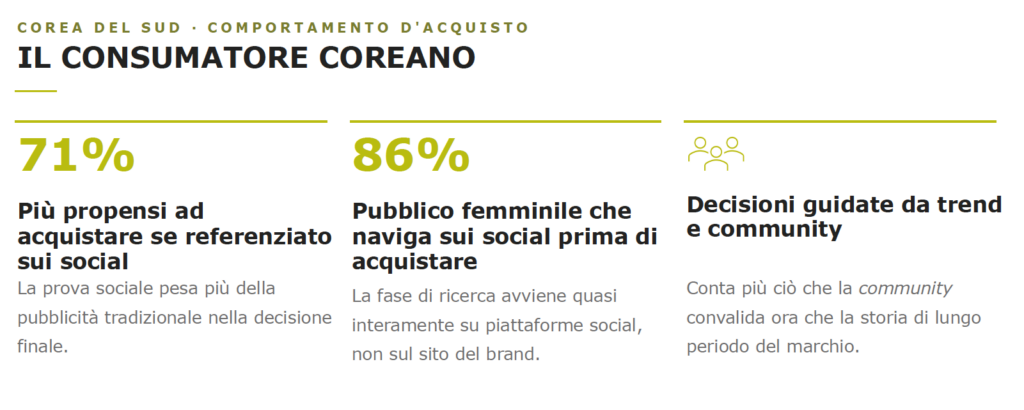
South-Korean consumers are very much influenced by social media and digital channels.
For many Italian companies, this has a very tangible consequence: if the brand isn’t optimized for smartphones, if the content isn’t designed for social media, and if the purchasing process isn’t fast, localized, and credible, the problem isn’t just one of communication. It’s one of market access.
Japan operates on a different schedule. It is a relationship-driven market, where trust is built through consistency, continuity, and the ability to fulfill commitments over time. Initial orders may come after 12–18 months of mutual evaluation; a stable business relationship can take several years to solidify.
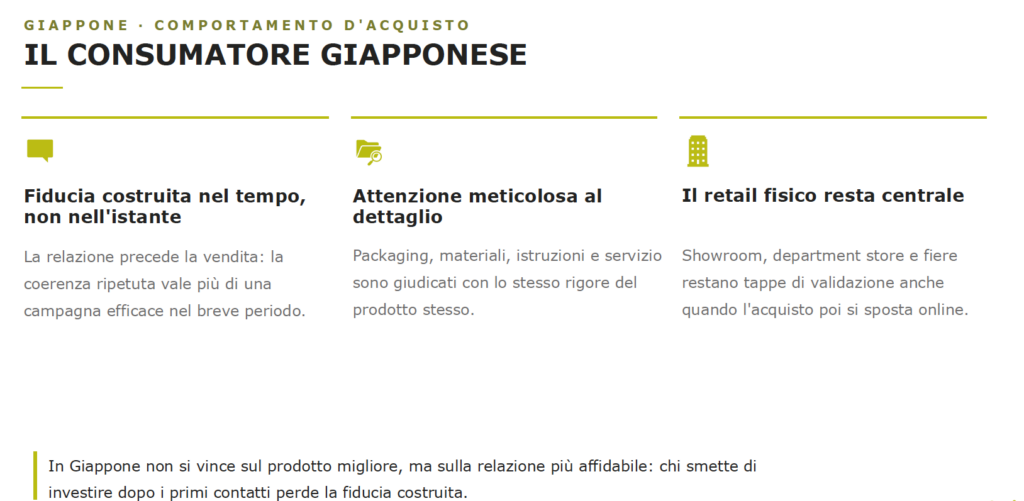
Trust is a huge component in business with Japanese customers.
The distribution system is also more complex: Sōgō shōsha (総合商社), sector-specific importers, brick-and-mortar retail, department stores, and selective channels. The right channel protects a brand’s positioning; the wrong one can erode it, even when it seems to open doors more quickly.
The operating rule is simple: in Japan, you don’t break into the market just by selling; you do so by building trust. In South Korea, you can move more quickly, but only if you understand which conversation the brand needs to join, through which channels, and with which local partner.
Where Potential Is Real: Sectors with Real Opportunities for “Made in Italy”
South Korea
In addition to its established leadership in leather goods, South Korea offers concrete opportunities in various sectors of Made in Italy.
The premium food & beverage sector is one of the most interesting, with a market worth over 140 billion euros and a strong Italian presence in olive oil, pasta, coffee, preserves, and products with high perceived value. Furniture and design also find a market environment that aligns well with Italy’s strengths: in this sector, positioning, experience, and the ability to communicate a product’s value matter more than volume.
Natural cosmetics represent another area to watch closely: in 2024, South Korean imports of Italian cosmetics reached $108 million, marking a 3.8% increase.
There is also an often-overlooked B2B component. South Korea is the world’s fifth-largest chemical market, a global logistics hub thanks to the Port of Busan, and a country committed to the energy transition, with significant targets for offshore wind and solar power by 2040.
For many Italian SMEs and mid-cap companies, therefore, the question is not just “How do I sell in South Korea?”, but “Where can I bring real expertise to an already highly developed industrial system?”
Japan
Wine is the most established market, but not the only one. Japan is the leading Asian market for Italian wine and continues to value the product’s quality, traceability, and culture.
In Japan, the precision machinery sector finds a market that places great emphasis on technical reliability, certifications, consistent quality, and after-sales service. In many cases, the initial price is less important than the ability to guarantee consistent performance and ongoing support.
The pharmaceutical, medical device, and cosmetics industries are also seeing sustained demand, driven by one of the world’s longest-living populations and a strong focus on health, well-being, and quality of life.
Fashion and luxury continue to play an important role, with selective consumers who remain loyal to brands that demonstrate consistency, quality, and attention to detail. Finally, the aerospace sector is opening up new opportunities for industrial and technological partnerships, particularly in light of the Italy-Japan Space Dialogue launched in May 2026.
A Real Case Study: The Same Brand, Two Completely Different Approaches
It’s worth sharing a specific, anonymized case study that clearly illustrates this operational difference.
An Italian premium footwear company, with manufacturing facilities in the Marche region, approximately 100 million euros in revenue, and an “accessible premium” positioning, entered both the Japanese and South Korean markets. Same brand, same product, but two completely different approaches.
In Japan, the process was gradual: market analysis, building brand awareness, expansion through selected distributors, and establishing specialized channels such as department stores, specialty stores, and exclusive importers. The timeline was longer than initially anticipated, partly due to the impact of COVID-19, but the approach proved consistent with a market that values continuity, control over distribution, and careful partner selection.
In South Korea, the strategy was different from the start: finding a local partner to open a flagship store in a high-end department store, establishing the retail channel, and launching the brand with the support of influencer marketing. In a market that is more responsive to premium fashion, large department stores and creators serve as platforms for visibility and positioning, not just distribution channels.
The operational insight is clear: for the same brand, Japan required a more gradual, relationship-based, and distribution-focused approach; South Korea allowed us to test and validate the premium positioning more quickly, but only because the channel and partners had been chosen with the same care.
Treating the two countries as a single “Asian market” would have resulted in a strategy that was wrong for both.
What the premium market really demands: less room for error, more consistency
“Premium” isn’t just a price point. It’s a set of expectations that applies to every touchpoint between the customer, the product, and the brand.
In Japan and South Korea, this means very low tolerance for defects, delays, or inconsistencies in packaging; after-sales service considered an integral part of the offering; disciplined price management across different channels; attention to the brand’s digital and physical reputation; and local partners capable not only of opening doors but also of sustaining and protecting the brand’s positioning over time.
In practice, the difference lies between a simple presence and a structured presence. Being on a marketplace, participating in a trade show, or having a generic distributor means simply being present. Building a structured presence means having a channel strategy, a consistent partner, localized content, clear commercial processes, and a constant ability to read the market.
It is the difference between an entry that generates visibility and an entry that produces results that can be sustained over time.
Less Improvisation, More Profit Margin
Japan and South Korea do not reward those who rush in. They reward those who come prepared, with a clear positioning, a reliable partner, and a willingness to invest before reaping rewards.
In return, they offer something that many other markets do not guarantee: stability in the business relationship, recognition of the product’s value, and potentially higher profit margins.
Italy already has a reputation in these two markets. We need to make better use of it.
For Italian SMEs, the real opportunity isn’t simply “going to Asia,” but carefully choosing where to enter, with what value proposition, and with what business model.
Roncucci&Partners supports Italian companies in evaluating foreign markets, defining their entry strategy, and finding local partners that best align with their corporate positioning.
Would you like to learn more about Japan and South Korea?
Write to us, and we’ll share the presentation shown during the webinar with you.
By Stella Occhialini and Giacinta Acerbi.
Related Articles: